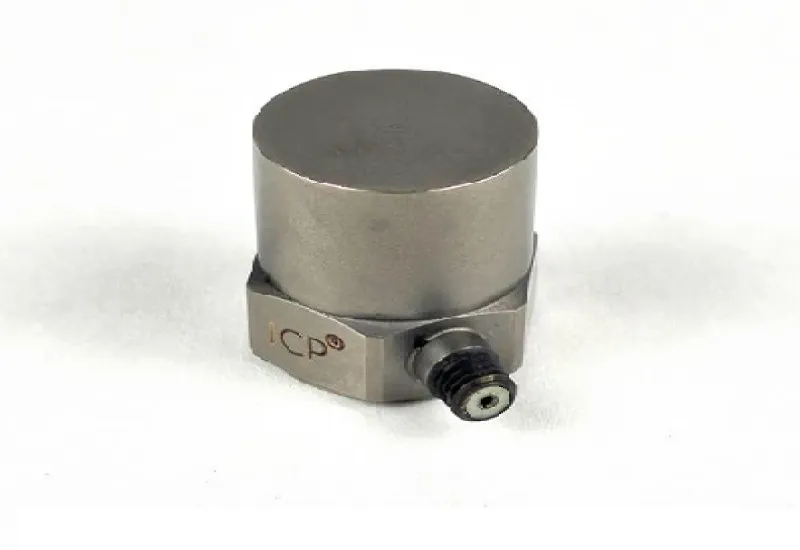
ICP® ACCELEROMETER
The ICP® accelerometer is a type of piezoelectric accelerometer that has a built-in integrated electronic circuit to generate a voltage signal proportional to acceleration
Platinum products; high sensitivity, quartz shear ICP® acceleration, 100 mV/g, 1 to 4000 Hz, 10-32 side connection
The 353B33 ICP® accelerometer
Features
- Sensitivity: 98.6 mV/g (10.05 mV/(m/s²)
- Measurement range: ±50 g pk (±491 m/s² pk)
- Broadband resolution: 0.0005 g rms (0.005 m/s² rms)
- Frequency range: (±5%) 1 to 4000 Hz
- Sensing element: Quartz
- Output: 9.8 VDC
- Weight: 0.95 oz (27 g)
How an ICP® Accelerometer Works:
- Piezoelectric: Uses a piezoelectric material, such as a quartz crystal, which generates an electrical charge when subjected to acceleration or vibration.
- Integrated electronics: The ICP® accelerometer has a built-in signal conditioning circuit that converts the charge generated by the piezoelectric material into a voltage signal directly proportional to the measured acceleration.
- Voltage output: Unlike other types of piezoelectric accelerometers that generate a charge signal, ICP® accelerometers provide a constant voltage output that is easy to measure and process.
What is an ICP® accelerometer used for?
ICP® accelerometers are widely used in applications that require measuring the acceleration or vibration of mechanical systems. Some of the main uses include:
- Vibration monitoring of industrial machinery: They are used in factories and industrial plants to detect abnormal vibration in equipment, enabling predictive maintenance and avoiding costly mechanical failures.
- Automobile and vehicle testing: They are used in vehicle testing to measure vibration and acceleration during performance or crash tests.
- Vibration analysis of structures: In civil engineering, they are used to monitor vibration in structures such as bridges and buildings, or even in seismic applications, helping to ensure structural safety.
- Condition monitoring systems: In continuous monitoring systems, such as those for wind turbines, generators, pumps, and other rotating equipment, ICP® accelerometers help detect unusual vibration that may indicate wear or failure.
- Vibration testing in laboratories: They are used in research environments to measure vibration in test equipment or in studies of materials and components.
- Aviation industry: In the aerospace industry, these accelerometers are used to measure acceleration in aircraft, spacecraft, or systems related to aviation and defense.
Advantages of ICP® Accelerometers:
- Standardized output: The output signal is a standard voltage, which makes it easy to integrate with data acquisition systems without additional signal conditioners.
- Integrated electronics: The signal conditioner is built into the accelerometer itself, which simplifies use and reduces the need for external equipment.
- High reliability: They are known for being rugged and suitable for working conditions in harsh industrial environments.
- Wide range: They can measure a wide range of accelerations, from low to high frequencies.
- Compatibility with standard amplifiers: The output is compatible with standard amplifiers and measurement systems, which makes it easy to integrate into testing and continuous monitoring.
Disadvantages:
- Requires external power: Even though the electronics are integrated, ICP® accelerometers need an external power supply to operate, generally 24 VDC.
- Low-frequency limitations: Although they are good for measuring vibration and rapid accelerations, they may not be ideal for detecting signals at very low frequencies.
ICP® 353B33 accelerometer specifications
|
PERFORMANCE |
||
|
Sensitivity (±5 %) |
100 mV/g |
10.19 mV/(m/s²) |
|
Measurement range |
±50 g pk |
±491 m/s² pk |
|
Frequency range (±5 %) |
1 to 4000 Hz |
1 to 4000 Hz |
|
Frequency range (±10 %) |
0.7 to 6500 Hz |
0.7 to 6500 Hz |
|
Frequency range (±3 dB) |
0.35 to 12000 Hz |
0.35 to 12000 Hz |
|
Resonant frequency |
≥22 kHz |
≥22 kHz |
|
Broadband resolution (1) |
0.0005 g rms |
0.005 m/s² rms |
|
Nonlinearity |
≤1 % |
≤1 % |
|
Transverse sensitivity |
≤5 % |
≤5 % |
|
ENVIRONMENTAL |
||
|
Overload limit (Shock) |
±10000 g pk |
±98100 m/s² pk |
|
Temperature range (Operating) |
-65 to +250 °F |
-54 to +121 °C |
|
Thermal response |
See Graph %/°F |
See Graph %/°F |
|
Base strain sensitivity |
0.0002 g/µε |
0.002 (m/s²)/µε |
|
ELECTRICAL |
||
|
Excitation voltage |
18 to 30 VDC |
18 to 30 VDC |
|
Constant current excitation |
2 to 20 mA |
2 to 20 mA |
|
Output impedance |
≤100 Ohm |
≤100 Ohm |
|
Output bias voltage |
7.5 to 12.0 VDC |
7.5 to 12.0 VDC |
|
Discharge time constant |
0.5 to 2.0 sec |
0.5 to 2.0 sec |
|
Settling time (within 10 % of bias) |
<25 sec |
<25 sec |
|
Spectral noise (1 Hz) |
320 µg/√Hz |
3139 (µm/sec2)/√Hz |
|
Spectral noise (10 Hz) |
70 µg/√Hz |
687 (µm/sec2)/√Hz |
|
Spectral noise (100 Hz) |
18 µg/√Hz |
177 (µm/sec2)/√Hz |
|
Spectral noise (1 kHz) |
6.4 µg/√Hz |
63 (µm/sec2)/√Hz |
|
Physical |
||
|
Size – Height |
0.93 in |
23.6 mm |
|
Size – Hex |
0.75 in |
19.1 mm |
|
Weight |
0.95 oz |
27 grams |
|
Sensing element |
Quartz |
Quartz |
|
Sensing geometry |
Shear |
Shear |
|
Housing material |
Titanium |
Titanium |
|
Sealing |
Welded hermetic |
Welded hermetic |
|
Electrical connector |
10-32 coaxial jack |
10-32 coaxial jack |
|
Electrical connection position |
Side |
Side |
|
Mounting thread |
10-32 Female |
10-32 Female |