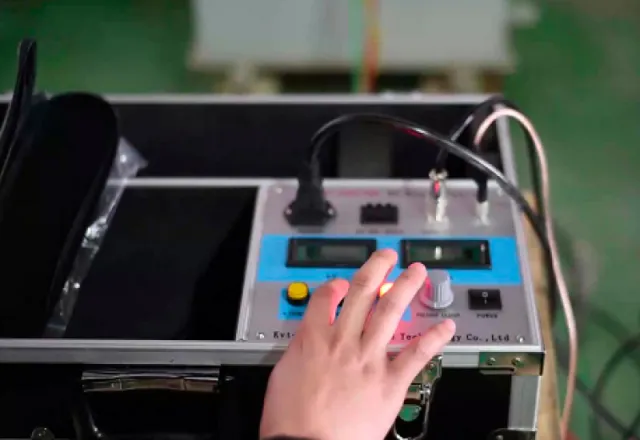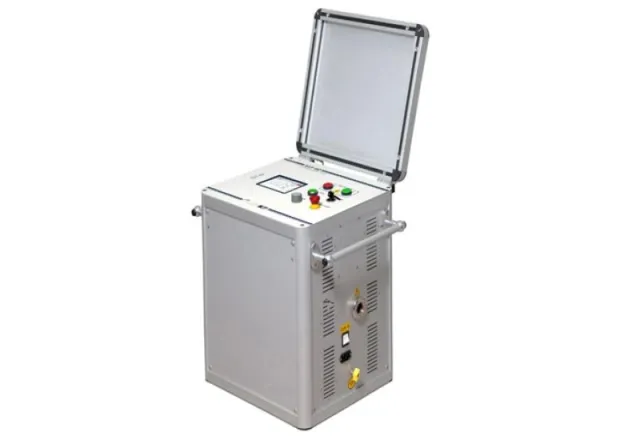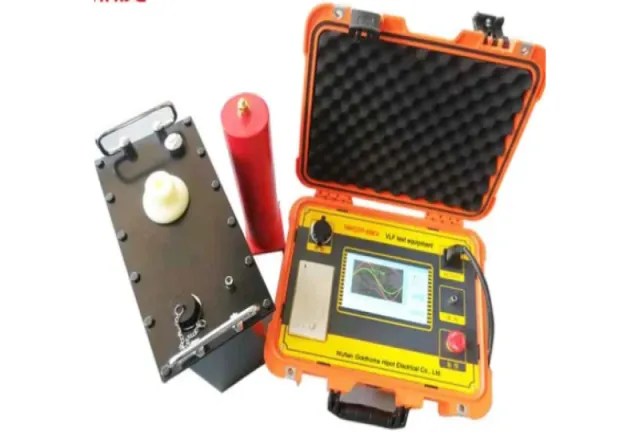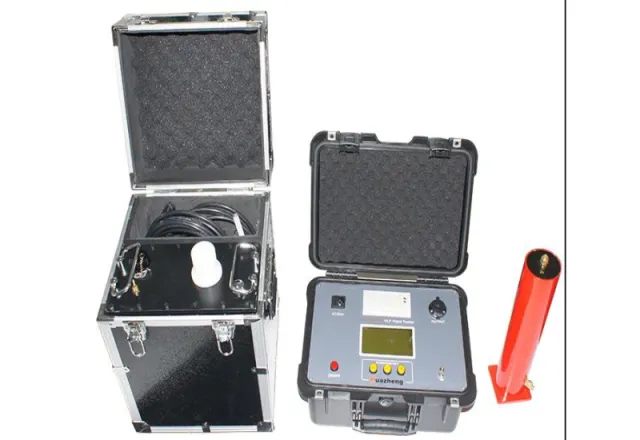
Medium-voltage cables rarely fail on the day they are installed. They fail months or years later, at a poorly made splice, a contaminated termination, or where water trees have grown into the insulation, and usually at the worst possible time. High-potential (hipot) and very low frequency (VLF) tests exist to find those defects under controlled conditions, before energization or during a planned outage. This guide explains why VLF has become the reference method for XLPE cables, how withstand and diagnostic tests differ, and how to prepare the site safely, including what Mexican regulations expect.
Why VLF at 0.1 Hz for XLPE cables
For decades, cables were proof-tested with DC hipot. For cross-linked polyethylene (XLPE) insulation, that practice is no longer recommended: DC does not reproduce the stress distribution the insulation sees in AC service, and it can leave trapped space charge in the dielectric. In aged, water-treed cables, this can accelerate failure once the circuit is re-energized. That is why the IEEE 400 family steers field testing toward AC methods.
The catch with testing at 60 Hz is power. A long cable is a large capacitor, and the reactive power needed scales with frequency. At 0.1 Hz, the required power is roughly 600 times lower than at 60 Hz, which makes portable field equipment practical. IEEE 400.2 is the guide specifically for field VLF testing of shielded power cable systems; it covers sinusoidal and cosine-rectangular waveforms and gives test voltages by cable voltage class and test type.
Withstand vs. diagnostic testing
Withstand test. An elevated voltage is applied for a defined time. If the cable does not break down, it passes. The point is to make a serious defect fail now, with the cable de-energized and under control, rather than in service. It is a go/no-go test and says nothing about remaining insulation life.
Diagnostic test. Measures an insulation property to assess condition and compare against other sections or earlier results. With VLF, the most common is tan delta; partial discharge and insulation resistance testing are complementary techniques.
A monitored withstand test records tan delta during the withstand period, combining an integrity check with trend data in a single voltage application.
Tan delta: what it measures and how to read it
Tan delta (dissipation factor) is the ratio of resistive to capacitive current through the insulation. Healthy XLPE has very low losses; moisture, water trees, and poor splices or terminations increase them. Measurements are taken in voltage steps, typically 0.5 U0, 1.0 U0, and 1.5 U0, where U0 is the cable’s rated phase-to-ground voltage. IEEE 400.2 looks at three indicators:
- Mean tan delta at the reference voltage.
- Stability over time (standard deviation of readings at one step).
- Tip-up, the difference between the high and low voltage steps.
Together these place the cable in categories along the lines of “no action required,” “further study advised,” and “action required.” The limits depend on insulation type and the edition of the guide, so take them from the current document. For any given cable, the trend over years is usually more telling than a single reading.
Acceptance vs. maintenance testing
| Type | When | Purpose | Voltage level |
|---|---|---|---|
| Installation | After pulling, before splices and terminations | Catch pulling damage | Per IEEE 400.2 |
| Acceptance | Complete system, before energizing | Verify cable, splices, and terminations | Highest of the three |
| Maintenance | During service life, at planned outages | Assess aging and plan replacements | Lower than acceptance |
In Mexico, NOM-001-SEDE-2012, the national electrical installations standard (broadly comparable to the NEC), requires installations to be tested before being placed in service and after any modification. That makes acceptance testing a required step for new substations and feeders, something HQ engineering teams planning a Mexican plant should build into the commissioning schedule. For maintenance, the reduced voltage aims to assess condition without overstressing aged insulation; even so, a withstand test can fail a weak spot, so schedule it when there is time to repair.
Safety and preparation
High-voltage tests must be performed only by qualified personnel under lockout/tagout. In Mexico, NOM-029-STPS-2011, the labor ministry (STPS) standard for electrical maintenance safety, applies alongside plant rules. Key steps:
- Isolate the circuit: de-energize, open and lock out both ends, verify absence of voltage, and ground before touching the cable.
- Disconnect equipment that must not see test voltage: transformers, potential transformers, surge arresters, and any connected load.
- Terminations: clean and dry them. Surface contamination causes leakage that skews tan delta and can lead to flashover. Check clearances to ground.
- Far end: barriers, signage, and a person with a radio at the remote end. Nobody enters the area during the test.
- Shields: grounded according to the test set’s procedure.
- Ground after the test: the cable stores charge. Discharge it through the test set, apply a solid ground, and leave it in place for as long as the manufacturer and procedure require before removing leads.
Test-day checklist
- Cable data: voltage class, U0, insulation type, length, number of splices, age.
- One-line diagram and signed work permits.
- Connected equipment identified and disconnected.
- Test voltages and duration set per IEEE 400.2 and the test type.
- Previous results for trend comparison.
- An agreed plan for what happens if the cable fails during the test.
FAQ
Can we still use DC hipot?
For XLPE cables, industry practice and IEEE 400 move away from DC field testing, especially on aged cable. DC remains useful in other applications and some other insulation types; base the choice on the applicable standard and the manufacturer’s recommendation.
Does VLF testing damage a healthy cable?
At the levels and durations in the guide, the test is intended not to degrade sound insulation. What it does is drive serious defects to failure that would otherwise fail in service.
Should we rent or buy a VLF test set?
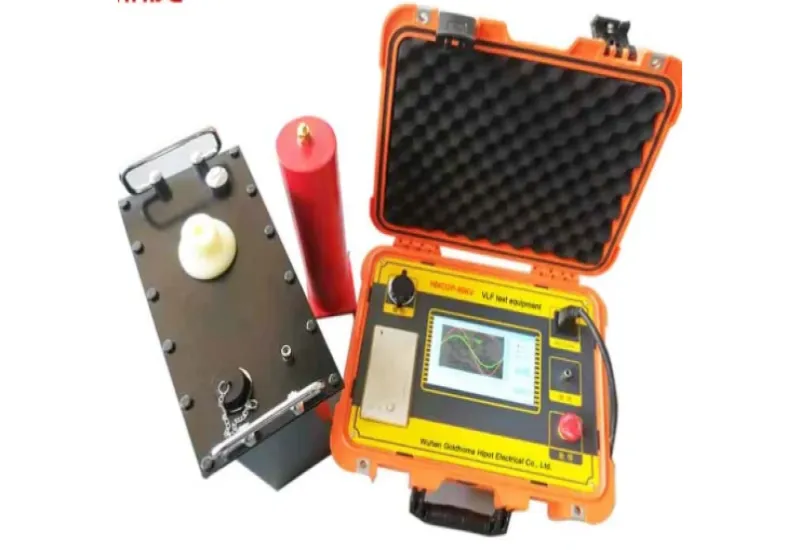
It depends on volume. Organizations that test cables often may consider buying a VLF hipot test set; for occasional testing, hiring the service with specialized staff is usually more practical.
CreativeIT Group performs on-site VLF testing of medium-voltage cables in Monterrey and throughout Mexico, including cable hipot testing in Puebla. Our own engineers run and analyze every test, no subcontractors, document it with photos and video, and can test in your presence, using instruments with NIST-traceable calibration. Request a quote at (81) 4777 6921 or (81) 2230 6079, on WhatsApp, or at info@creativeit.mx. We reply the same day, Monday to Saturday, 10:00 to 18:00.