Advanced Evaluation of Insulation Systems for Aerospace, Defense and High-Reliability Applications
The dielectric strength of air changes as atmospheric pressure decreases. A system that works properly at sea level can exhibit partial discharge, arcing or dielectric failures when operating at high altitudes or in partial-vacuum environments.
For this reason, the aerospace, aeronautics, defense and advanced electronics industries require specialized testing under low-pressure conditions.
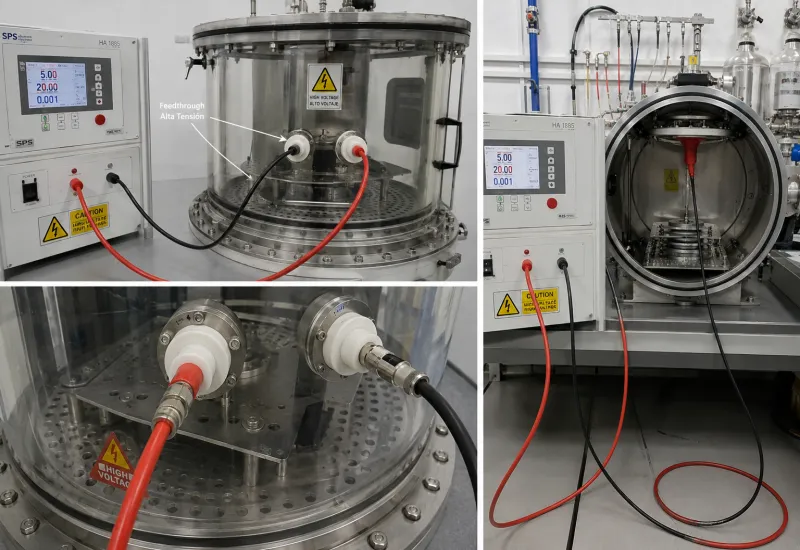
Our laboratory can perform AC and DC hipot tests combined with altitude simulation using a vacuum chamber.
Why Is It Important?
When atmospheric pressure decreases:
- The dielectric strength of air changes.
- Effective insulation distances are altered.
- The risk of partial discharge increases.
- Arcing between conductors can occur.
- The likelihood of catastrophic failure increases.
Available Tests
AC Hipot Under Vacuum
Simulation of operating conditions at altitude.
DC Hipot Under Vacuum
Evaluation of electronic systems and power components.
Insulation Resistance
Verification of the overall condition of the dielectric system.
Leakage Current Evaluation
Recording and analysis of electrical behavior under reduced pressure.
Combined Tests
Our laboratory can combine:
Temperature + Hipot
Evaluation of insulation under controlled heating.
Humidity + Hipot
Analysis of moisture absorption.
Vacuum + Hipot
Altitude simulation.
Vacuum + Temperature + Hipot
Conditions used in aerospace and high-reliability programs.
Vacuum + Humidity + Hipot
Advanced evaluation for research and development.
Applications
- Satellites
- Space equipment
- Avionics
- Military systems
- Aeronautical electronics
- Power converters
- Telecommunications equipment
- University research
- Technology development centers
Standards and Technical References
- IEC 60068-2-13 (Low atmospheric pressure)
- IEC 60068-2-14 (Change of temperature)
- NASA Test Standards
- RTCA DO-160
- MIL-STD 810
- Customer-specific requirements
Technical Differentiator
Few laboratories in Mexico can combine high-voltage testing, leakage current measurement, thermal conditioning, controlled humidity, liquid immersion and vacuum simulation within a single validation strategy.
This capability makes it possible to reproduce real operating scenarios, identify failure mechanisms before they reach the end user, and generate solid technical evidence for development, certification and quality assurance programs for high-reliability products.