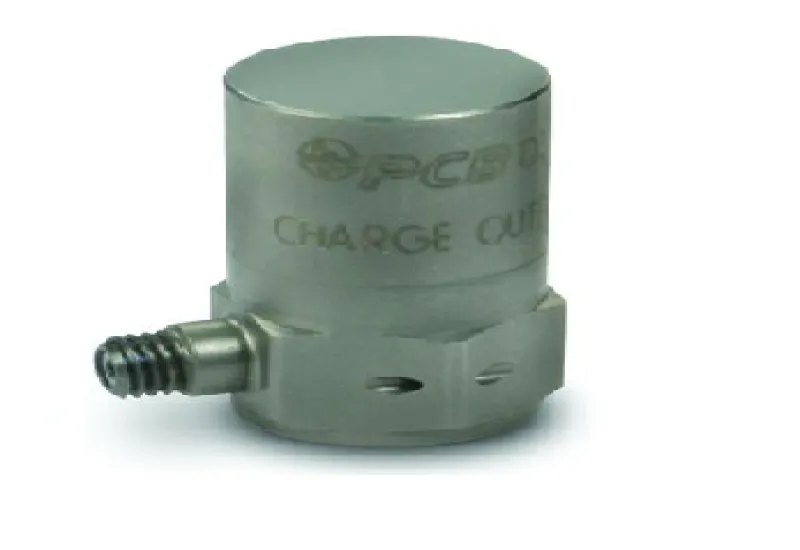
A charge output accelerometer is a type of sensor that measures acceleration (the rate of change of velocity) and generates a signal in the form of an electrical charge proportional to the acceleration. These accelerometers generally use piezoelectric materials, which can generate an electrical charge when a force or acceleration is applied to them. This charge signal must be converted or amplified to be processed by other electronic systems.
We have the Piezotronics 357B61 accelerometer
High temperature, ceramic compression, charge output acceleration, 10 pC/g, 5 kHz, 10-32 side connection (-65 °F to +900 °F), supplied with a 3 m hardline cable.
- Sensitivity: (±10 %) 10 pC/g (1.02 pC/(m/s²))
- Measurement range: ±1000 g pk (±9810 m/s² pk)
- Frequency range: (±5 %) 5000 Hz
- Weight: 30 g (1.1 oz)
What is a charge output accelerometer used for?
- Vibration measurement: Charge output accelerometers are particularly useful for measuring high-frequency vibration or rapid impacts. This is ideal in applications such as:
- Vibration testing of vehicles or machinery: To monitor the structural health of a machine or vehicle by detecting abnormal vibration.
- Industrial machinery monitoring: To detect impending failures in equipment such as pumps or motors.
- Impact testing applications: They are very effective in impact or shock testing, where rapid acceleration is measured in sudden-force situations, such as those found in the automotive or aerospace industry.
- Acceleration monitoring: They are used to measure changes in acceleration of systems that may be subject to dynamic motion, such as:
- Seismic monitoring systems: To detect small ground movements or vibrations.
- Monitoring systems on aircraft and spacecraft: To measure acceleration during takeoff, landing, or maneuvers.
- Wearable device applications: In some cases, charge output accelerometers can be used in portable monitoring devices, such as sensors that measure physical activity or posture.
- Dynamic force measurement: In applications where dynamic forces applied to a structure need to be measured, such as in bridges, buildings, or industrial machines.
Advantages of charge output accelerometers:
- High sensitivity and accuracy: Charge output accelerometers are very sensitive and can detect even small variations in acceleration.
- Fast response: They can measure rapid accelerations thanks to their piezoelectric nature.
- Durability: They can operate in harsh industrial environments thanks to their ruggedness and resistance.
Disadvantages:
- Requires signal conditioning: The charge-form output signal must be conditioned or converted to voltage or current, which may require additional circuitry.
- Sensitivity to temperature changes: The charge output can be affected by thermal variations, which may require compensation.