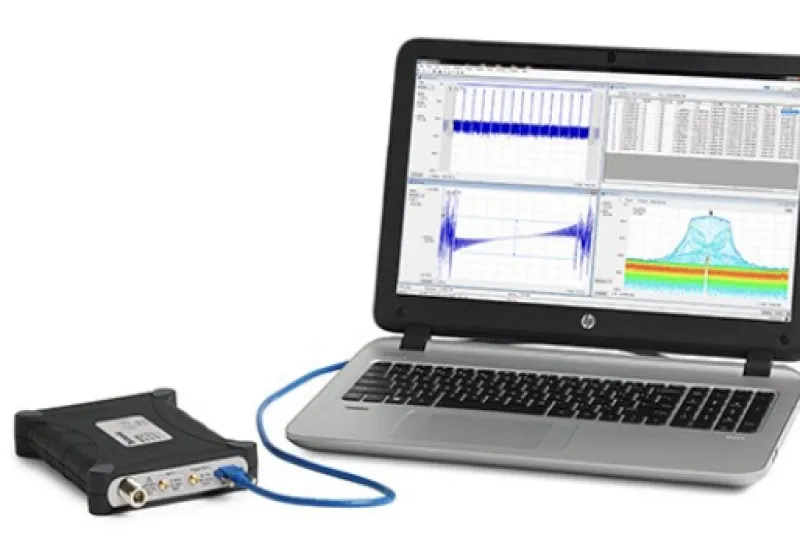
Optimize your RF measurements and analysis with the Tektronix RSA306B Portable Real-Time Spectrum Analyzer from CreativeIT Group!
Key features:
- Frequency range of 9 kHz to 6.2 GHz, perfect for a wide variety of applications.
- Real-time analysis function for instant response and interference detection.
- High resolution and measurement accuracy for detailed analysis of the electromagnetic spectrum.
- Portability and compact design for field or laboratory use.
- Intuitive, easy-to-use interface for a smooth user experience.
- Advanced software for data analysis and report generation.
Main uses:
- Wireless Network Monitoring: Identify and resolve interference problems in WiFi, Bluetooth, LTE and other networks.
- RF Signal Analysis: Characterize the performance of wireless devices and systems.
- Research and Development: Perform advanced measurements in communications and electronics laboratories.
- Interference Detection: Locate sources of interference and optimize the electromagnetic spectrum.
- Real-Time Spectrum Analysis: View and analyze signals in real time for critical applications.
Rental with CreativeIT Group:
- Rental flexibility by the day, week or month according to your needs.
- Specialized technical support and advice to get the most out of the equipment.
- Fast delivery and pickup service at the end of the rental period.
- Competitive prices and customized rental options for companies and professionals.
A portable real-time spectrum analyzer is a device used to analyze and visualize electromagnetic signals over a frequency range of 9 kHz to 6.2 GHz. This type of instrument is especially useful in radio frequency (RF) and telecommunications applications, and in environments where the electromagnetic spectrum must be monitored and analyzed accurately and in real time.
The Tektronix RSA306B, for example, is capable of capturing and analyzing signals over a wide frequency range with high resolution and speed. It can detect and display the amplitude and frequency of various signals present in the electromagnetic spectrum, which makes it possible to identify interference, analyze the performance of wireless devices, and perform advanced measurements in the field of communications and electronics.
A real-time spectrum analyzer is a fundamental tool for engineers, technicians and professionals who work with RF signals, since it allows them to take detailed measurements and make informed decisions in real time.
The main difference between a portable real-time spectrum analyzer such as the Tektronix RSA306B and a conventional spectrum analyzer lies in its ability to capture and analyze signals in real time.
-
Conventional spectrum analyzer:
- It works by capturing a set of samples of the signal in the time domain and then applying a Fourier transform to display the signal in the frequency domain.
- This process can take time, especially for complex signals or signals with rapid changes in the spectrum.
- Measurements and displays are slower and may have some delay compared to a real-time spectrum analyzer.
-
Portable real-time spectrum analyzer
- It can capture and analyze signals instantly, without the need to perform a prior data capture.
- It offers real-time measurements and displays, which is crucial for applications where changes in the electromagnetic spectrum must be detected and responded to quickly.
- They are better suited to continuous monitoring, interference detection, transient analysis and dynamic measurements in complex RF environments.
-
Wireless Network Monitoring:
- If you are working on a wireless network installation and need to detect interference or transient signals that may affect network performance, a real-time spectrum analyzer such as the RSA306B would be useful. You can quickly identify the sources of interference and take corrective action in real time.
- On the other hand, if you want to analyze the frequency spectrum of a specific Wi-Fi signal to determine its bandwidth or power levels at different frequencies, a standard spectrum analyzer would be more suitable. It will let you take detailed measurements of the signal at a given moment.
-
Radio Frequency (RF) Signal Analysis in the Laboratory:
- If you are running laboratory tests and need to capture and analyze RF signals that vary rapidly over time, the real-time spectrum analyzer would be essential. For example, you might be testing IoT devices that transmit data in short intervals and need to verify signal quality in real time.
- On the other hand, if you are characterizing a specific RF signal to determine its center frequency, occupied bandwidth or modulation characteristics, a standard spectrum analyzer would be more appropriate. It will let you take precise, detailed measurements of the signal under stable conditions.
-
Troubleshooting Communication Equipment:
- If you are troubleshooting communication equipment such as two-way radios or transmission systems, a real-time spectrum analyzer would help you quickly identify whether external interference may be affecting communication.
- On the other hand, if you need to analyze the signal quality of a communication device under controlled conditions, a standard spectrum analyzer would be more useful for measuring parameters such as signal-to-noise ratio, signal power and distortion.
- Interference Signals: These are elusive signals that may be present in a spectrum and interfere with the signal you are analyzing. For example, in an urban environment, you could encounter elusive interference signals from electronic devices, wireless networks, or even broadcasting.
-
Modulation Signals: If you are working with communication systems, you could encounter elusive modulation signals that indicate the presence of a modulated signal in the spectrum. These signals can be analyzed to determine the type of modulation used (AM, FM, QAM, etc.) and other parameters related to data transmission.
-
Background Signals: These elusive signals are those that make up the “background noise” in a spectrum. They can be generated by various electronic devices or natural phenomena, and it is important to identify and filter them to obtain accurate measurements of the signals of interest.
-
Transient Event Signals: In some cases, you could encounter elusive signals that indicate the presence of transient events or brief bursts of activity in the spectrum. These events can be important for detecting intermittent interference or temporary phenomena that affect signal quality.
The real-time spectrum analyzer is preferable for analyzing elusive signals because of its ability to capture, analyze and provide detailed information about dynamic and transient signals in real time, which is essential for diagnosing and troubleshooting electronic and communication systems.
The real-time spectrum analyzer is better for analyzing elusive signals:
-
Real-Time Capture: Because it is a real-time analyzer, it can capture and analyze elusive signals as they occur. This is crucial for identifying transient events, intermittent interference or other signals that can affect the performance of a system in real time.
-
Greater Sensitivity and Bandwidth: Real-time spectrum analyzers often have greater sensitivity and bandwidth than standard spectrum analyzers. This allows them to detect weak signals or brief events that might go unnoticed by other measuring devices.
-
Dynamic Analysis: By being able to analyze elusive signals dynamically, you can obtain detailed information about the frequency, amplitude, modulation and other characteristics of the signals in real time. This is crucial for identifying the cause of interference problems or for characterizing complex signals.
-
Storage and Post-Processing Capability: Many real-time spectrum analyzers have storage and post-processing capabilities that make it possible to review and analyze previously captured data. This is useful for investigating past events, identifying recurring interference patterns and taking corrective action.
-
Intuitive User Interface: Real-time spectrum analyzers usually have intuitive user interfaces and advanced display functions that make it easier to identify and analyze elusive signals. This is especially useful for engineers and technicians who need to work efficiently in complex environments.
In summary, the key difference lies in a real-time spectrum analyzer’s ability to provide instantaneous measurements and displays, which makes it ideal for applications where speed and responsiveness are essential. On the other hand, conventional spectrum analyzers are better suited to applications where speed is not critical and detailed analysis of complex signals can be performed with more time and computing resources.
Power up your projects with the Tektronix RSA306B Portable Real-Time Spectrum Analyzer from CreativeIT Group! Contact us today for more information and reservations.