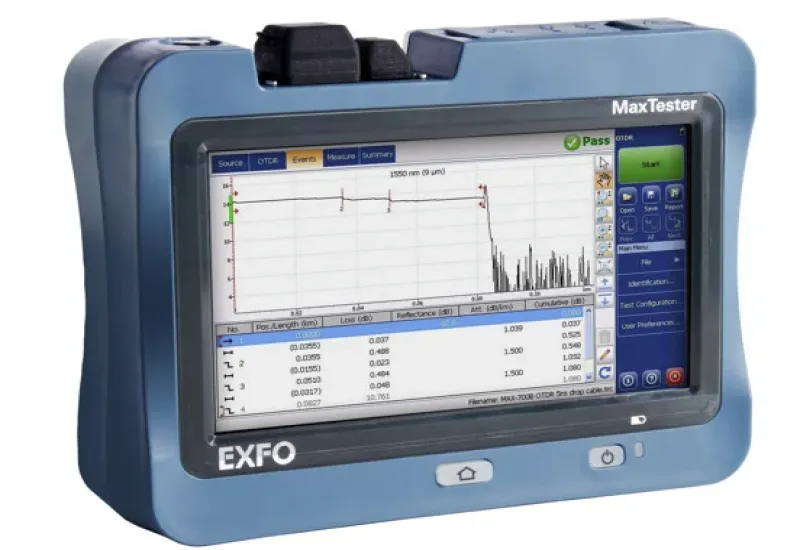
OTDR rental is a service we offer for fiber optic measurements. OTDRs are used to detect and locate faults in optical fibers, such as breaks, defective splices, bends, splices or fusions, or signal losses. Renting an OTDR can be a convenient and economical option for companies or technicians who need this type of equipment on a one-off or temporary basis, without having to invest in buying their own OTDR.
An OTDR, which stands for Optical Time Domain Reflectometer, is a device used in fiber optic networks to measure attenuation and locate reflection or loss events along an optical fiber. This instrument sends pulses of light through the fiber and records the amount of light reflected as a function of time. With this information, the OTDR can determine the location and magnitude of discontinuities in the fiber, such as splices, connectors, and other reflection events. It is an essential tool for maintenance and troubleshooting in fiber optic networks.
An OTDR is used in circumstances related to optical fiber. Here are some situations in which an OTDR is needed:
-
Fault Location: When there are problems in a fiber optic network, such as signal loss or outages, an OTDR can be used to locate and measure the distance to the point of failure.
-
Fiber Characterization: To evaluate the quality and characteristics of a newly installed optical fiber, an OTDR can provide detailed information on attenuation, reflectance, and other parameters.
-
Preventive Maintenance: It can be used in maintenance tasks to verify the condition of the fiber optic network and anticipate possible problems before they affect performance.
-
Network Certification: When installing new fiber optic networks, an OTDR is used to certify that the installation meets the required standards and specifications.
In summary, the OTDR is a crucial tool for the maintenance, diagnosis, and certification of fiber optic networks, providing detailed information on the quality and integrity of optical connections.
An optical time domain reflectometer (OTDR) is a fiber optic instrument used for the characterization, troubleshooting, and maintenance of fiber optic telecommunications networks.
Principles
The accuracy and usefulness of OTDR testing would not be possible without the science that precedes it. By understanding the physical laws that characterize this instrument, you gain invaluable insight into the principles that govern how an OTDR works.
When Albert Einstein put forward the theory that electrons could be stimulated to emit a specific waveform, he had just planted the seed for what would eventually make the first working laser possible in 1960. Although the applications envisioned at the time probably did not include using optical fiber for telecommunications around the world, this technology has become the essence of 21st-century connectivity.
Over the years, many groundbreaking discoveries have been applied in the development of OTDR testers.
OTDR-related definitions
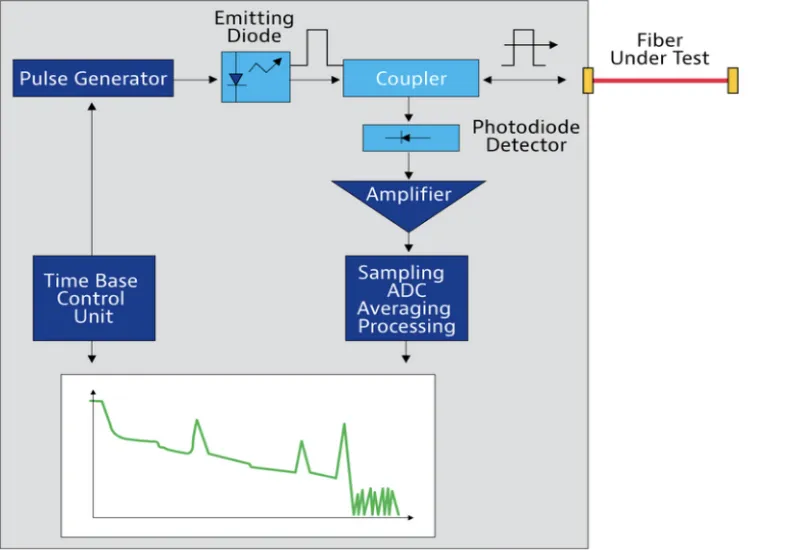
An OTDR also consists of a laser diode source, a photodiode detector, and a high-precision timing circuit (or time base). The laser emits a pulse of light at a given wavelength, and this light pulse is transmitted along the fiber under test. As the light pulse travels through the fiber, portions of the transmitted light are reflected or refracted, or backscattered by the fiber toward the OTDR’s photodetector. The intensity of this returning light and the time it takes to return to the detector indicate the amount of loss (insertion and reflection), the type, and the location of an event on the fiber link.
Basics and functions
The inherent value of OTDR testing lies in diagnosing the condition of a fiber optic cable that could not otherwise be determined. This is paramount when the link contains several splices and several connections that are prone to failure.
Optical return loss (ORL) and reflectance can be used to diagnose the conditions under which a greater-than-expected loss occurs at a given point in the fiber run. Total fiber attenuation can also be evaluated, since the degree of backscatter is indicative of this value.
These same principles are used to make invaluable distance measurements when repair, troubleshooting, or maintenance needs arise. The end of the fiber link or a fiber break can be detected by means of Fresnel reflection, since a break or the end of an unterminated fiber also represents a change of medium (from glass to air). In addition to the overall fiber length, the distance to faults, splices, and connections can be determined with a graphical display of the analysis results.
Types of OTDR
As the functional usefulness of OTDR testing grows alongside demand for better storage, reporting, accuracy, and test speed, the range of products continues to diversify. The two predominant categories are benchtop and portable. A benchtop OTDR is basically a feature-rich instrument with a direct AC power supply, while a portable or compact OTDR is typically a lightweight, battery-powered device designed for field use.
Beyond this basic division, the features and options an OTDR offers must be carefully considered according to the intended use. One important aspect is the type of fiber to be tested: multimode, single-mode, or both. Another variable is the length of the fiber under test. Products designed for long-distance applications typically have higher dynamic range capabilities, which would not be needed for tests on shorter fiber optic links, such as FTTA.
Usability features also vary by product, another reason why the application for which the OTDR is chosen should be the most important factor when selecting a product. For example, a lightweight product may not be necessary for a stationary test. However, if the tests will be carried out by technicians climbing base station towers or at a dynamic site, the weight, battery life, and ruggedness of the product’s housing become important.
Parameters
Given the wide variety of OTDR testing applications, meticulously configuring the parameters for each task is paramount to obtaining accurate measurements. Using an automatic test function may be sufficient for some tests, although it is still advisable to configure the parameters manually because of differences in the length, type, and complexity of fiber optic runs. Once the appropriate parameters have been established for testing a given fiber optic run, these OTDR test settings can be recalled from the instrument’s memory the next time that run or a similar one is evaluated.