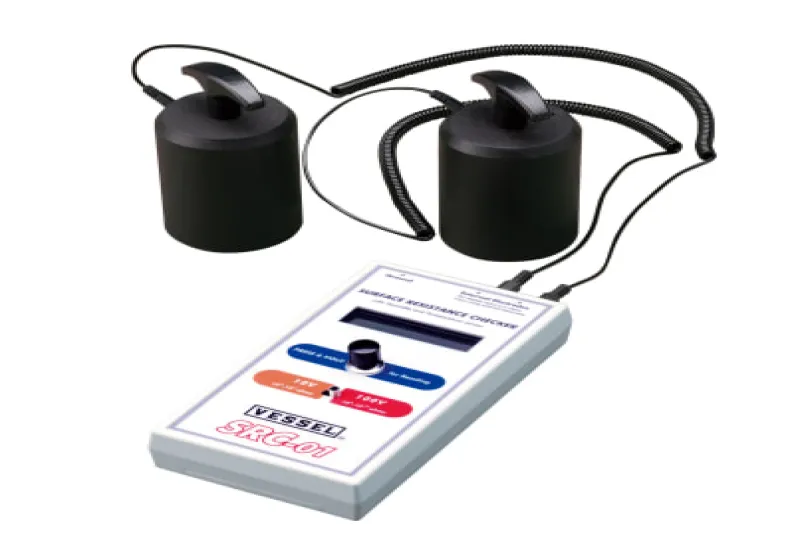
Surface Resistivity Testing | Creativeit Group
What Is Surface Resistivity?
Surface resistivity is a measure of how well a material allows or impedes the flow of electric current along its surface. It is expressed in ohms per square (Ω/□) and is used especially for thin materials such as coatings, films, inks or textiles, where thickness does not allow conductivity to be evaluated by volume.
Unlike volume resistivity, which measures through the material, surface resistivity evaluates the electrical behavior between two points on the surface, and is key for materials used in electrostatic discharge (ESD)-sensitive environments.
When current flows over the surface of a material, its path is determined by:
-
The chemical nature of the material (conductive, polymeric, insulating, charge-loaded).
-
The uniformity of the coating or film.
-
Ambient humidity and temperature.
-
The roughness or texture of the surface.
|
Material Type |
Range (Ω/□) |
Classification |
|
Conductor |
< 10⁵ |
Conducts easily |
|
ESD dissipative |
10⁵ – 10¹¹ |
Drains charge gradually |
|
Insulator |
> 10¹¹ |
Retains electric charge |
|
Material Type |
Key Application |
|
Conductive inks |
Printed circuits, sensors, EMI shielding |
|
ESD coatings |
Tables, floors, tools, enclosures |
|
Antistatic textiles |
Cleanroom garments, curtains, mats |
|
Doped plastics |
Housings, automotive components, connectors |
|
Technical films |
PET sheets, polyimides, ITO films |
|
Foams and packaging |
Protection of sensitive electronic components |
|
Functional glass |
Displays, smart windows, touch sensors |
Importance in Industry
The risks of uncontrolled electrostatic charge buildup are:
Damage to sensitive electronic circuits (ICs, MEMS, sensors).
Ignition risk in environments with explosive gases or dusts.
Failures in the production of semiconductors or optical devices.
Electromagnetic interference from residual electrostatic fields.
Measuring and controlling surface resistivity is critical for meeting industrial safety, product quality and electromagnetic compatibility (EMC) requirements.
At Creativeit Group, we use certified equipment for measurements in accordance with international standards. The most commonly used methods are:
- ASTM D257 – Electrical resistance of insulating materials.
- IEC 61340-5-1 / ANSI/ESD S20.20 – Protection of electronic devices against ESD.
- ESD STM11.11 / 11.12 / 11.13 – Specific methods for textiles, films and surfaces.
- MIL-STD-3010 – Military testing of protective packaging.
- ISO/IEC 60093 – Electrical resistance of solid insulating materials.
Contact Us Today
Do you need to validate your ESD coatings, inks or packaging?
Creativeit Group – Electrical Testing Laboratory
Service in Mexico
WhatsApp: 81 17866 0768