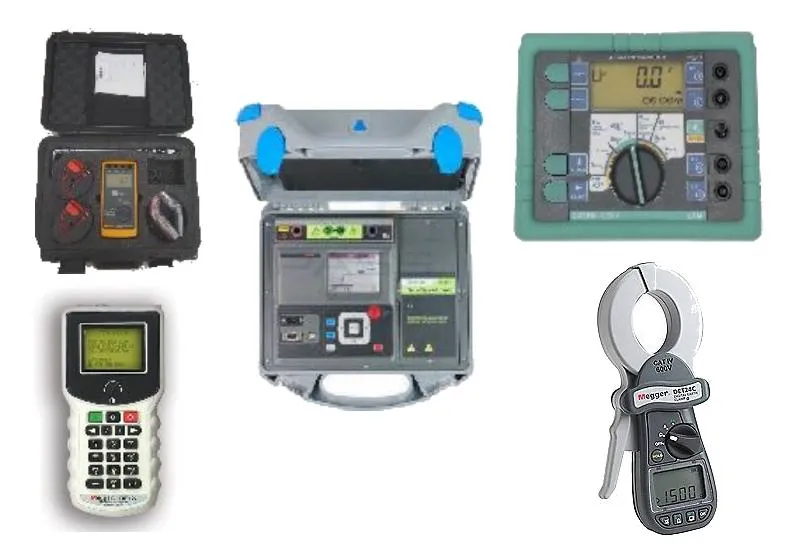
We perform grounding (earthing) resistance and soil resistivity measurements for grounding systems and lightning rods in Monterrey, in accordance with IEEE 81, IEC 60364-6, IEC 62561 and NFPA 780, and we use only the latest professional equipment from prestigious brands such as Fluke, Metrel and Megger to take the measurements. We check resistivity for cathodic protection. Soil resistivity testing using the 4-pin Wenner method, ASTM G57.
Ground testing and lightning rods are two important aspects of protection against lightning strikes and electrical safety. Here is a brief explanation of what each one involves:
Ground testing:
Ground testing is the process of verifying the electrical resistance of the grounding system of an electrical installation.
The grounding system is crucial for providing a safe path for electrical current to flow to ground in the event of a fault, lightning strike or other emergency.
During ground testing, an earth resistance tester is used to determine the electrical resistance between the ground electrode and the grounding system.
A low ground resistance is desirable because it means the grounding system is effective at dissipating fault currents or surges.
Ground testing is an integral part of preventive maintenance in electrical installations to ensure their safety and proper operation.
Lightning rods:
Lightning rods are devices designed to protect buildings, structures and electrical equipment against the damaging effects of lightning strikes.
They work by providing a low-resistance path for lightning current to travel to ground in a controlled and safe manner.
Lightning protection systems typically consist of an air-termination system (metal tips) that attracts the strike, a down-conductor system (conductive cables) that channels the current to ground, and an earth-termination system (ground electrodes) that disperses the energy of the discharge into the soil.
Lightning rods require periodic maintenance to ensure they function properly, including visual inspections, conductor continuity tests and ground resistance tests.
It is important that lightning rods comply with electrical safety codes and standards to ensure their effectiveness in protecting against lightning.
In summary, ground testing focuses on verifying the effectiveness of the grounding system of an electrical installation, while lightning rods are devices designed to protect against the effects of lightning strikes. Both are essential to ensure electrical safety in buildings and electrical systems.
We are a team of foreign engineers with extensive, verifiable experience in industry and in hazardous locations such as oil platforms, gas pipelines and the mining industry. We have personnel with a signatory letter (carta de signatario) for access to oil platforms. We travel throughout Mexico, and we can also rent Fluke equipment with a technician included to assist with connections and menu operation at a lower cost.
Identification of electrodes and/or grounding system configuration.
Review of the physical condition of electrodes, inspection pits and electrode-to-cable connections.
Identification of sources of static electricity.
Ground electrode resistance measurements (earth tester).
Continuity measurements of connections (electrode-to-cable and cable-to-cable).
Verification of the height and physical condition of the lightning rod, as well as the physical condition of the mast where applicable.
Review of the lightning rod down conductors (route, connections and protective conduit).
Verification of the number of lightning strikes on the counter (where applicable).
Review of the lightning rod’s protection angle.
Delivery of a report and certificate of the service performed.
CFE (Mexico’s Federal Electricity Commission) recommends measuring and recording, at least every twelve months, the resistance values of the grounding grid and the continuity at connection points in order to comply with the guidelines of NOM-022-STPS (Mexican workplace static-electricity safety standard). We also perform tests on circuit breakers and connectors with micro-ohm meters.
Frequent measurement of the resistance of ground systems and lightning rods is vital to ensure the correct operation of the grounding safety system, which must be present in all electrical installations.
It is advisable to measure the resistance of ground systems and lightning rods at least once a year, in order to detect whether there is any fault in the system, whether any conductor has lost continuity, whether sulfation has developed on the connectors, and whether the resistivity is as specified or the system needs to be modified to bring it to acceptable values.
Any equipment connected to an electrical supply can put the facilities or people at risk if it is not properly grounded. Sometimes, even though the connection physically exists, measuring the resistance of the ground system and lightning rods shows that the system is not functional and does not provide the conductivity required to discharge a surge to ground.
To avoid variability in the measurement of ground system and lightning rod resistance, the measuring instruments should be calibrated by an accredited laboratory using traceable standards, and the measurement method should be kept constant.
There are different methods for measuring the resistance of ground systems and lightning rods, including the fall-of-potential method, which is the most widely used, the selective method, the stakeless method, and the two-pole method. Each has its advantages and disadvantages and its own applications depending on site or operating conditions.