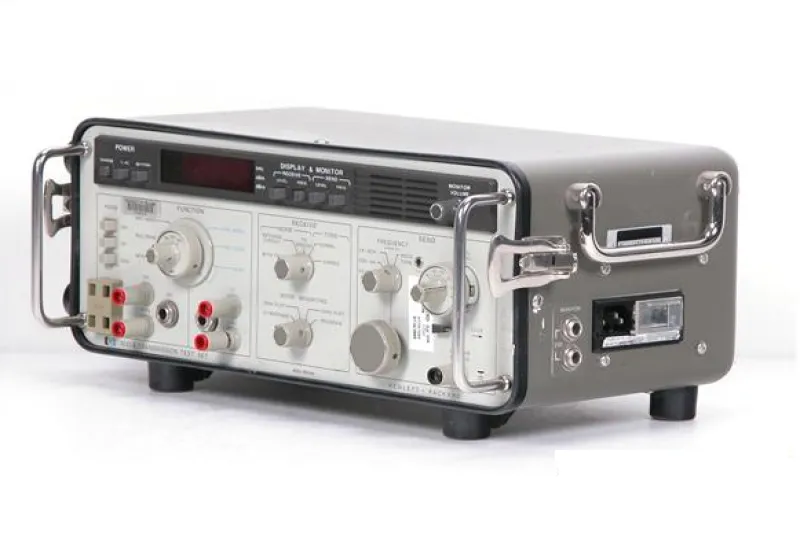
The HP 3551A is a transmission test set. This device is designed primarily to evaluate and analyze signal transmission in communication systems, as well as to test electronic components in the fields of telecommunications, networks and radio frequency (RF) equipment.
Main features and functions of the HP 3551A:
- Transmission parameter measurement:
- The HP 3551A can measure various transmission parameters in RF systems and telecommunications equipment, such as attenuation, gain, impedance, frequency response and more.
- It is useful for evaluating how a signal is transmitted through a system, from source to receiver, by analyzing losses or distortions.
- Evaluation of RF systems and components:
- This instrument is ideal for measuring the performance of components such as amplifiers, filters, cables, antennas and other devices in RF and communication systems.
- It provides a detailed analysis of how these components affect the signal during transmission.
- Frequency testing:
- The HP 3551A allows testing over a wide range of frequencies, typically in the RF range, which is necessary for checking the effectiveness and characteristics of communication systems.
- Its ability to evaluate signals in the frequency domain makes it valuable for verifying communications equipment, both analog and digital.
- Signal quality analysis:
- It allows tests to ensure that transmitted signals maintain the desired quality throughout the transmission system, detecting problems such as noise, distortion or signal loss.
- Network calibration and testing:
- It can be used to test and calibrate transmission networks and communication systems, ensuring that performance parameters are within the desired specifications.
- This is essential for systems that require reliable, high-quality performance.
- Versatility of use:
- Although it is oriented mainly toward testing RF and telecommunications systems, its ability to measure and analyze signals makes it suitable for a wide range of applications in research, development and maintenance of electronic equipment.
Common uses:
- Research and development: In telecommunications and electronics laboratories, it is used to evaluate new components and systems before deployment.
- Telecommunications testing: Useful for testing equipment such as transmitters, receivers and other devices used in radio frequency communications.
- RF equipment maintenance: Assists in the diagnosis and maintenance of existing transmission systems and communication equipment.
- Signal quality verification: Used to ensure that signals transmitted through communication networks are within quality specifications.
Key benefits:
- Signal measurement accuracy: Provides detailed, accurate measurements of transmission quality, helping to detect problems in communication systems.
- Ease of use: Designed to be easy to use, allowing complex tests to be performed without a long learning curve.
- Wide frequency range: Covers a wide range of RF frequencies, which makes it suitable for testing in a variety of telecommunications applications.
Its ability to measure key parameters such as attenuation, gain and signal quality makes it an indispensable tool in research, development and test laboratories for electronic and communications equipment.