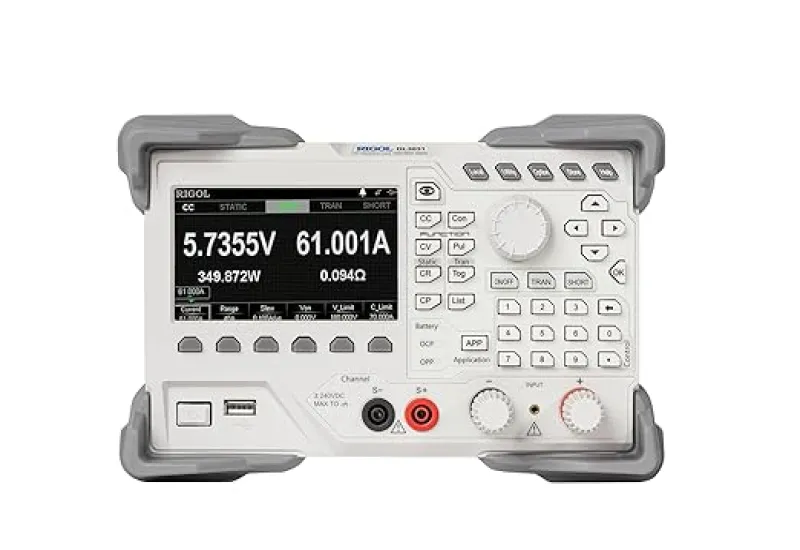
DC electronic loads are devices designed to simulate a load on a direct current power source. They are mainly used in testing of power supplies, batteries, chargers and other electronic systems that operate on direct current. These electronic loads make it possible to verify the performance, capacity and reliability of devices under controlled load conditions.
Features of DC electronic loads:
- Simulation of different types of load:
- DC electronic loads can simulate resistive loads, constant current (CC) loads or constant power loads.
- They can dynamically adjust the amount of current drawn, allowing tests under conditions that imitate real use of the devices.
- Current and voltage adjustment:
- DC load testers allow adjustment of both the current and the voltage so that tests can be performed over a wide range of conditions. This makes it possible to test devices with different voltage or current specifications.
- Real-time measurement:
- Many DC electronic loads have displays that show in real time parameters such as voltage, current, power and energy consumed by the load. This makes it easier to monitor tests and detect possible faults in the devices under test.
- Heat dissipation capability:
- Some electronic loads are equipped with heat dissipation systems, since the passage of current through a load generates heat. This ensures that the device does not overheat during tests.
Common uses of DC electronic loads:
- Power supply testing:
- Power supplies that provide direct current (such as those for computers, electric vehicle chargers, and renewable energy sources) can be tested with DC electronic loads to verify that they maintain stable voltage and current under different demand levels.
- Battery and charger testing:
- Electronic loads are used to simulate a battery’s power consumption and measure its current delivery capability as the battery discharges. They are also used to evaluate the performance of battery chargers, checking whether they can maintain the right voltage and current while charging.
- Simulation of real load conditions:
- Electronic loads make it possible to simulate typical load conditions to verify how power systems react in real-world scenarios, where loads can vary unpredictably.
- Testing in renewable energy systems:
- In solar or wind powersystems, where loads are not always constant, DC electronic loads help test charge controllers and energy storage systems by simulating the variable behavior of the load.
- Power dissipation testing:
- In applications such as the automotive industry or portable electronic devices, electronic loads make it possible to evaluate how power is dissipated under different load conditions, helping to avoid overheating and ensure energy efficiency.
Types of DC electronic loads:
- Resistive electronic load:
- Simulates a resistive-type load, in which current is directly proportional to voltage (Ohm’s law). This is a basic form of testing that allows verification of the power supply’s behavior under simple conditions.
- Constant current (CC) electronic load:
- Maintains a constant current during the test, regardless of variations in voltage. It is used to evaluate power supplies in scenarios where a constant current is required, such as in some battery charging systems.
- Constant power electronic load:
- Maintains a constant power during the test. This means that as voltage varies, current also changes to ensure that the total power (voltage x current) remains constant. This load is useful for evaluating devices that operate under constant power conditions.
- Programmable electronic load:
- Allows the user to define a specific load curve that imitates the device’s usage conditions in real-world situations. This type of load is more flexible and can be used in a wider variety of tests.
Benefits of DC electronic loads:
- Test accuracy: They provide an accurate, controlled simulation of loads, which ensures that electronic devices can be tested under realistic and controlled conditions.
- Time savings: They allow quick, repeatable testing, which is crucial in mass production processes or in the maintenance of electronic systems.
- Versatility: They are useful for testing a wide range of devices, from chargers and batteries to complex power supplies.
- Safety: They help avoid risks such as overload or equipment damage by providing a controlled environment for testing.