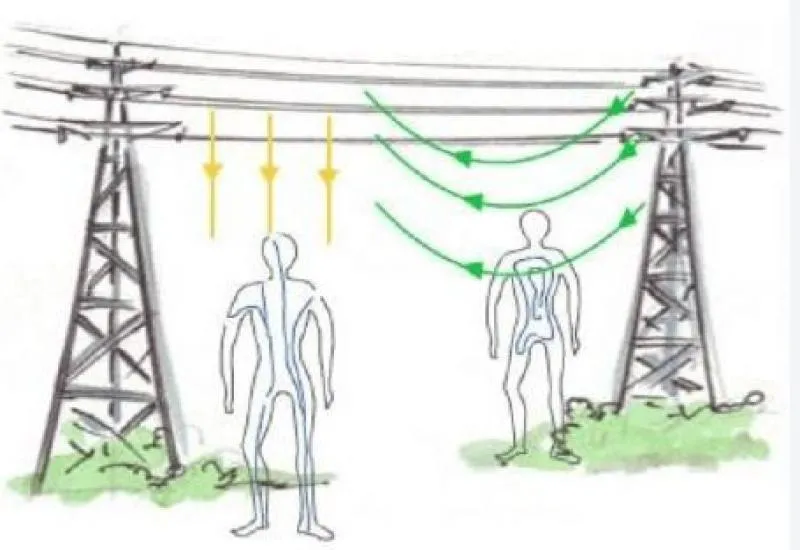
Measurement of Low-Frequency Electric and Magnetic Fields
We conduct electromagnetic field studies associated with transmission lines, substations, electrical installations and power equipment, using specialized instrumentation for measuring low-frequency electric and magnetic fields.
Our service characterizes the field levels present on land, in industrial buildings, in offices and in work areas near electrical infrastructure, through measurements taken at different distances and heights.
For power-frequency field measurements we use specialized Holaday / ETS-Lindgren HI-3604 instrumentation, designed specifically for low-frequency electric and magnetic field studies. The HI-3604 performs True RMS measurements and covers a nominal range of 30 Hz to 2 kHz, including the 60 Hz power frequency.
What Do We Measure?
Electric Field — E
The electric field is normally expressed in:
V/m — volts per meter
We evaluate the electric field strength at the measurement points and how it varies with distance and position within the study area.
The HI-3604 has a wide dynamic range for electric field measurement, from 1 V/m to 200 kV/m, according to current ETS-Lindgren specifications.
Magnetic Field — B / H
The magnetic field can be expressed using different quantities and units:
- µT — microtesla
- mG — milligauss
- A/m — amperes per meter
The HI-3604 can display the magnetic field in units such as gauss, tesla or amperes per meter.
This lets us present the study results according to the technical or regulatory criterion used for the evaluation.
Studies Near Transmission Lines
High-voltage lines generate electric and magnetic fields that can vary depending on many factors, including:
- System voltage.
- Electric current.
- Phase configuration.
- Conductor geometry.
- Conductor height.
- Distance from the line.
- Electrical load of the system.
- Position of the measurement point.
- Height above ground level.
For this reason, a single spot measurement does not always provide a sufficient characterization.
Our procedure can include field profiles versus distance, showing how field levels decrease as you move away from the electrical infrastructure.
Assessment for Industrial Buildings and Facilities
When an industrial building, plant or facility is planned near a transmission line, we can perform a characterization of the existing electromagnetic field in the area of interest.
The study can consider:
? Distance to the line
Measurements from different positions relative to the centerline of the transmission line.
? Height
Measurements at different heights to determine the vertical distribution of the field.
⚡ Electric field
Characterization of the electric field in V/m.
? Magnetic field
Characterization of the magnetic field in µT, mG or A/m.
? Field profile
Obtaining the variation of the field with distance.
? Construction area
Evaluation of the levels present inside and around the planned construction area.
Specialized Instrumentation
Holaday / ETS-Lindgren HI-3604
For power-frequency field studies we use the HI-3604 ELF Survey Meter, an instrument specialized for measuring low-frequency electric and magnetic fields.
The instrument features:
- Measurement of electric and magnetic fields.
- True RMS response.
- Nominal frequency range of 30 to 2000 Hz.
- Auto-ranging.
- LCD display.
- Bar graph for identifying peak values.
- Internal memory for up to 112 measurements.
- Analog output for signal acquisition.
- Optical interface for remote reading.
In addition, our system includes the HI-3616 Fiber Optic Remote Control, which allows remote readings over a fiber optic link. ETS-Lindgren identifies this accessory specifically as a remote control option for the HI-3604.
Measurement and Data Logging
The HI-3604 has internal memory to store up to 112 readings, making it possible to document measurement points during a field campaign.
It also has an analog output from the sensor/preamplifier, allowing external instrumentation to be connected to observe or record the signal.
This is particularly useful when you need to study the time behavior of the signal in addition to the RMS value.
Study Methodology
Our procedure can be structured as follows:
01 — Site inspection
Identification of transmission lines, towers, conductors and the area of interest.
02 — Definition of points
Establishing a measurement grid that considers distance, height and the location of the facility.
03 — Electric field measurement
Recording of electric field levels in V/m.
04 — Magnetic field measurement
Recording of magnetic levels in the corresponding units.
05 — Distance profile
Measurement at different positions to determine how the field varies with respect to the electrical infrastructure.
06 — Analysis
Processing and comparison of the results against the technical or regulatory criterion applicable to the project.
07 — Technical report
Delivery of results, tables, plots, point locations, methodology, instrumentation used and technical conclusions.
What Project Information Do We Need?
To perform the study properly, we request the following when available:
- Project location.
- Site plan.
- Location of the towers.
- Distance between the building and the line.
- Planned height of the building.
- Nominal line voltage.
- Conductor configuration.
- Approximate conductor height.
- Information provided by CFE (Mexico’s Federal Electricity Commission) or the project manager.
- Requested standard or acceptance criterion.
When CFE or the project owner requires a specific distance from the line, we can take measurements at different positions to characterize the behavior of the field as a function of distance.
Standards and Technical Criteria
Low-frequency electric and magnetic field measurements can be performed using methodologies established in national and international standards applicable to the type of installation and the objective of the study.
Relevant technical references include NMX-J-610/4-110-ANCE (Mexican standard on methods for measuring electric and magnetic field levels generated by electric power systems).
The specific standard or acceptance criterion must be defined according to the requirements of the project, the relevant authority or the customer. Performing a measurement according to a given method does not in itself mean that the method establishes the project’s acceptance limit.
Why Conduct a Study Before Building?
A preliminary assessment reveals the field levels existing on the site and provides a technical basis for the design and placement of the facility.
The study can be especially useful when there are:
High-voltage transmission lines
Electrical substations
Transmission towers
Power transformers
Industrial facilities
Workplaces near electrical infrastructure
The information obtained can support decisions on engineering, area layout, equipment placement and project technical documentation.
Professional Measurement Service
At Análisis Eléctricos we combine specialized instrumentation with measurement procedures aimed at producing technically documented results.
Our goal is to provide a quantitative characterization of the low-frequency electric and magnetic fields present in the study area and deliver results that can be analyzed against the applicable technical criterion.
Request an Electromagnetic Field Study
Is your project near a high-voltage line?
Contact us to define the measurement points, scope of the study, required instrumentation and applicable technical criteria.