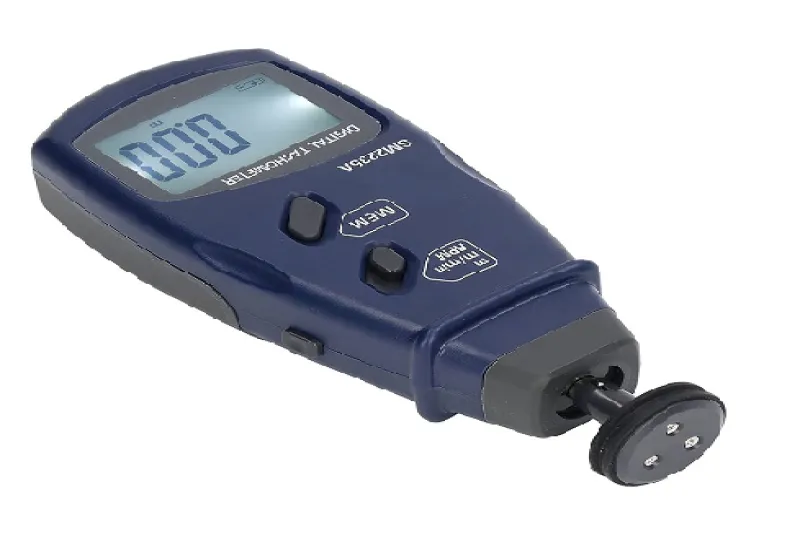
Digital tachometers are for sale from stock, and we also have units for rent. The tachometer, or rev counter, is a device that measures the rotational speed of the motor shaft in revolutions per minute (RPM). This information tells us the speed at which it is turning, when a car delivers more power, and even the best moment to shift gears. An electronic tachometer uses a magnetic pickup located near a rotating part of the engine to produce electrical pulses at a frequency proportional to engine speed.
Mechanical and electronic tachometers work differently. A mechanical tachometer works much like a mechanical speedometer. A flexible cable with a rotating shaft connects a moving part of the engine or transmission to the gauge. Inside the instrument, the rotating shaft controls the position of a needle to indicate engine speed. An electronic tachometer uses a magnetic pickup placed near a rotating part of the engine to produce electrical pulses at a frequency proportional to engine speed. The gauge circuitry converts the pulse frequency to display engine RPM on a digital readout. A tachometer helps measure how hard your vehicle’s engine is working, regardless of whether the vehicle has an automatic or manual transmission (road vehicle) or is a marine vehicle (boat).
Machinery normally has an optimal working speed; if it runs too fast, it can be damaged. If it runs too slowly, there may be a problem with the machine or its power source. For example, poor lubrication, mechanical friction or an excessive load may be slowing it down. A tachometer accurately indicates the working speed.
For example, in a vehicle with an automatic transmission, a tachometer can tell you whether the transmission’s shift points are within range or whether the transmission is slipping. In a vehicle with a manual transmission, you can use a tachometer to determine the optimal time to shift gears (but it is not mandatory).
Meanwhile, in marine applications, a tachometer lets you identify the best operating range for your engine while making sure you do not exceed the engine’s maximum speed. It can also secondarily inform the decisions a boat owner makes regarding performance and fuel consumption.