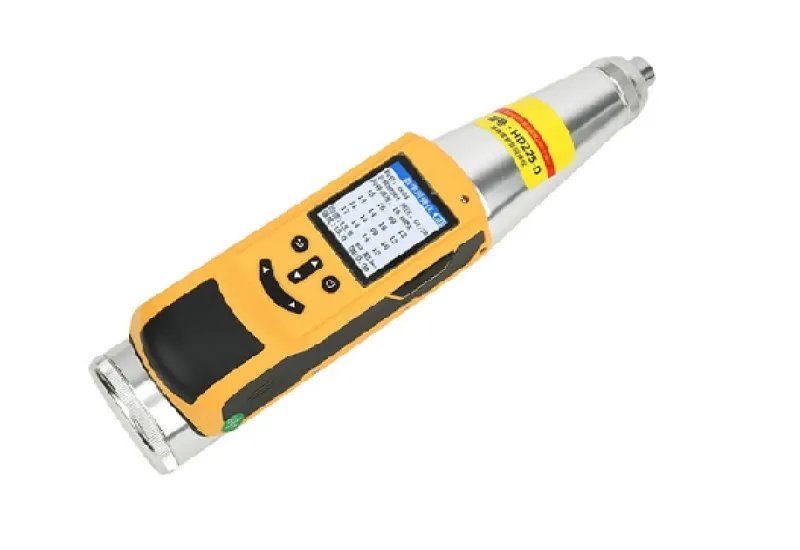
We have a practical, economical tool for non-destructive measurements of the surface hardness of concrete, which allows its compressive strength to be estimated quickly and on site.
The concrete impact tester, also known as the Schmidt Hammer or rebound hammer, is a device used to measure the surface hardness of concrete and estimate its compressive strength non-destructively. This type of test is quick, easy to perform and provides immediate results, which makes it a very useful tool in the construction industry for evaluating concrete quality on site.
How the Schmidt Hammer (Impact Tester) works
The basic principle of the Schmidt hammer is the relationship between the surface hardness of concrete and its ability to resist compression. The device works through the following mechanism:
1. Impact: The hammer, which consists of a spring-driven plunger, is released against the concrete surface.
2. Rebound: The plunger strikes the concrete surface and rebounds. The rebound distance of the plunger is proportional to the hardness of the concrete surface.
3. Energy measurement: The amount of rebound is measured on a scale on the hammer, generally expressed in units known as the impact value or rebound number. The greater the rebound, the greater the surface hardness of the concrete.
Steps for taking a measurement with the Schmidt Hammer:
1. Placement: The hammer is placed perpendicular to the concrete surface in the area to be evaluated.
2. Actuation: The hammer is triggered, and the plunger strikes the surface. The rebound of the plunger is captured and recorded on the instrument’s scale.
3. Reading: The rebound value obtained (impact value) is noted from the scale. This value is used to estimate the compressive strength of the concrete.
4. Correlation: In some cases, to obtain more accurate results, the rebound value is correlated with the results of previous destructive compressive strength tests, so that the strength of the concrete can be estimated more accurately.
Characteristics of the Schmidt Hammer:
Portable: Easy to carry and use on site.
Fast: Delivers results in seconds.
Non-destructive: Does not require drilling or damaging the structure.
Easy to use: Does not require highly specialized personnel to perform the tests.
Limited accuracy: Accuracy depends on the uniformity of the concrete surface and on factors such as the aging of the material.
Advantages of using the Schmidt Hammer:
Non-destructive: The concrete structure is not affected, which allows multiple tests to be performed without compromising the integrity of the structure.
Fast and economical: Allows tests to be performed quickly and without having to cut or extract concrete samples.
Minimal maintenance: Requires very little maintenance and is easy to operate.
Use on existing structures: Ideal for evaluating the strength of already-built structures without causing damage.
Limitations of the Schmidt Hammer:
Measures the surface only: The device only evaluates the surface hardness of the concrete, so it does not always reflect the total strength of the material at depth.
Dependence on surface quality: Measurement accuracy can be affected by factors such as the roughness or condition of the concrete surface.
Not suitable for all types of concrete: For very soft or very hard concrete, or for surfaces that are uneven, results may be less reliable.
Requires correlation: To obtain an accurate estimate of compressive strength, it is necessary to establish a correlation between the impact value and the actual strength through prior destructive testing.
Factors that affect Schmidt Hammer results:
Temperature: Extreme temperatures can affect the reading, so it is recommended to perform tests under controlled conditions.
Moisture: The moisture content of the concrete can influence the results.
Surface type: A rough, dirty or poorly prepared surface can alter the rebound and therefore the results.
Age of the concrete: Concrete that has cured for longer tends to have higher strength, which can affect the rebound value.
Applications of the Schmidt Hammer:
Construction quality control: Allows quick on-site tests to verify the strength of the concrete used in a structure.
Inspection of existing structures: Evaluation of concrete strength in buildings, bridges, tunnels, pavements, etc., without drilling or extracting samples.
Concrete durability monitoring: Helps identify possible weak or deteriorated areas in concrete structures.
Research and development: Study of new concrete mixes or curing methods.