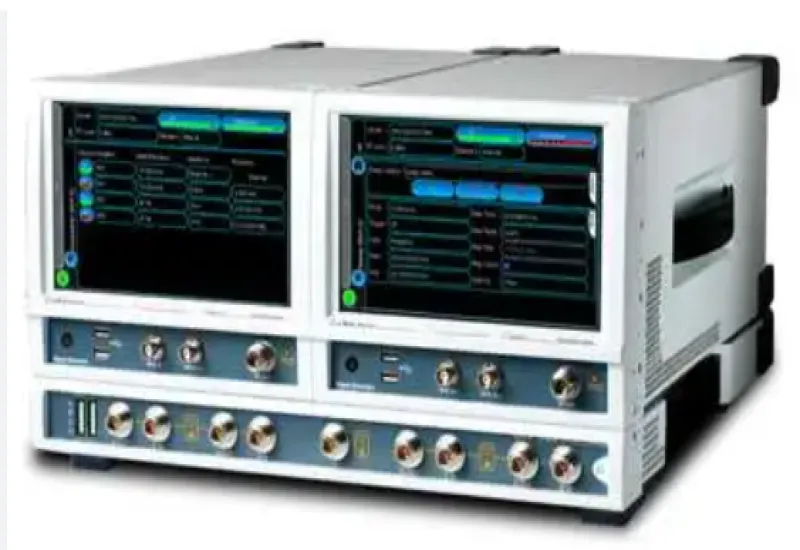
We have signal generators with analog and vector digital modulation.
SIGNAL GENERATOR: ANALOG, VECTOR OR ARBITRARY?
Function generators are basic tools in the design and testing of electronic systems. With these tools you can generate electrical signals with specific characteristics, such as sine and square waves, and modulations such as AM, FM and PM, among other signals.
Analog signal generators are used to produce high-quality signals: 1 Spectral purity (no unwanted harmonics) 2 Low inherent signal noise 3 Stable phase, frequency and amplitude. They are used as a basis for system calibration and testing, analog modulation testing, electromagnetic compatibility (EMC) testing, RF system development and other applications.
Vector signal generators are specialized instruments for generating signals for high-frequency digital communications. They can generate signals for encodings such as Wi-Fi, GPS, radar and digital television. They are also used for specific encodings such as QAM, MIMO, QPSK and LTE. Some of their important features are modulation bandwidth, adjacent channel power adjustment, low reflection coefficient, etc.
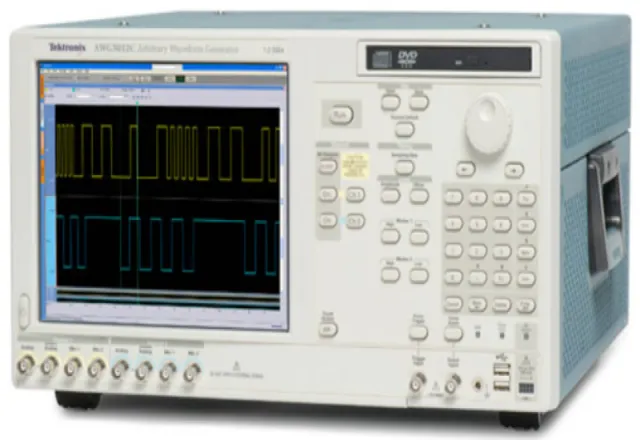
They have a floating-point computation module that lets them calculate their modulation in real time and store it in RAM. This gives the instrument the ability to change waveform, allowing signals to be combined to, for example, analyze different responses of a system. It can output any combination of waveforms, with the restriction of a specific number of cycles per signal. Another important point is that it does not have the radio frequency handling capabilities that vector generators have on their own.
Digital-to-analog signals are the next conversion we will discuss in this chapter. These techniques are also called digital modulation techniques.
Digital modulation provides more information capacity, high data security and faster system availability with high-quality communication. Digital modulation techniques are therefore in greater demand because of their ability to transmit larger amounts of data than analog modulation techniques.
There are many types of digital modulation techniques, as well as combinations of them, depending on need. Of all of them, we will discuss the most notable.
ASK – Amplitude shift keying
The amplitude of the resulting output depends on the input data, whether it should be a zero level or a variation of positive and negative, depending on the carrier frequency.
FSK – Frequency shift keying
The frequency of the output signal will be high or low, depending on the input data applied.
PSK: phase shift keying
The phase of the output signal is shifted depending on the input. These are mainly of two types, namely binary phase shift keying BPSK
and quadrature phase shift keying QPSK
, depending on the number of phase shifts. The other is differential phase shift keying DPSK
which changes phase according to the previous value.
M-ary encoding
M-ary encoding techniques are methods in which more than two bits are transmitted simultaneously in a single signal. This helps reduce bandwidth.