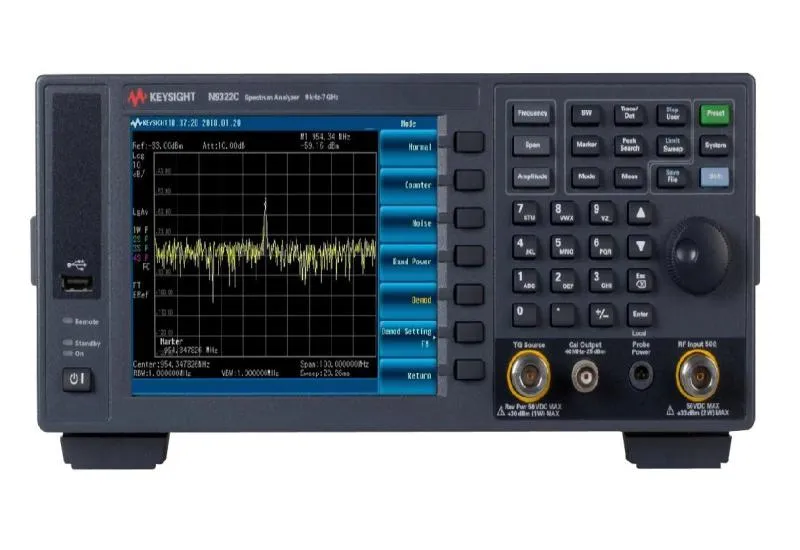
Spectrum analyzers help engineers explore the frequency domain, understand signal outputs and identify unknown signals. We offer a wide range of products from the leading names in the industry, including Keysight, Tektronix, Rohde and Schwarz and Anritsu, so you can always find the right spectrum analyzer.
Together with independent expert advice and a range of smart solutions for flexible, fast access, we will always find you the perfect solution.
A spectrum analyzer is an electronic device used to analyze and display the characteristics of the frequency spectrum of electrical or electromagnetic signals. These signals can be radio waves, audio signals, communications signals, radar signals and many other forms of signals.
The spectrum analyzer shows how signal energy is distributed along the frequency axis, making it possible to identify the frequencies present and their relative amplitude. Through this display, engineers and technicians can obtain valuable information about the nature of the signals and the presence of interference or problems in electronic systems.
The basic operation of a spectrum analyzer involves the following steps:
- Signal capture: The spectrum analyzer receives the input signal through a connector or an antenna. This signal is typically an electrical signal that varies in frequency.
- Conversion to intermediate frequency (IF): The input signal is converted to an intermediate frequency for processing. This is usually done to lower the frequency and allow more efficient processing.
- Frequency analysis: The signal at the intermediate frequency is divided into small frequency intervals or “bins.” The signal amplitude in each bin is measured and plotted on the vertical axis of the spectrum analyzer.
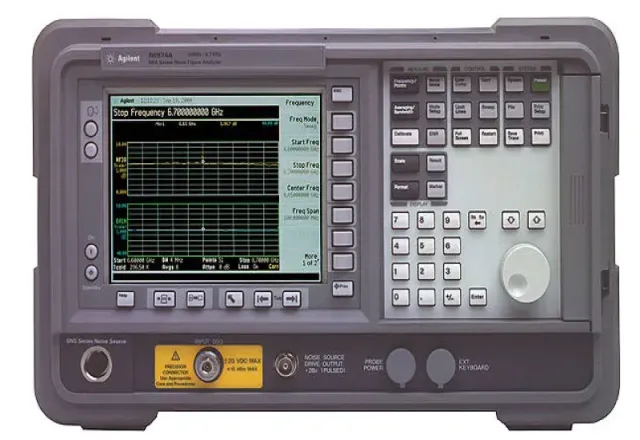
- Display: The measured amplitude values are plotted on a graph, where the horizontal axis shows frequency and the vertical axis shows amplitude. This representation is known as the “frequency spectrum.”
- Interpretation and analysis: Users can analyze the spectrum to identify the signals present and determine their amplitude, frequency, bandwidth and other characteristics. They can also detect interference or unwanted signals that may affect system performance.
Spectrum analyzers can have different frequency ranges, resolution, sensitivity and additional functions. Some advanced models can capture signals in real time and perform more complex measurements, such as modulation analysis and identification of specific communication protocols.
What a spectrum analyzer is used for
The spectrum analyzer is a fundamental tool in electronics and communications, since it can perform a variety of functions related to the analysis and characterization of electrical or electromagnetic signals.
Some of the main applications and uses of the spectrum analyzer are:
Radio frequency signal analysis: Spectrum analyzers are widely used to analyze radio frequency signals in telecommunications applications such as wireless networks, radio systems, mobile telephony and radar systems, among others. They make it possible to view and measure the power and amplitude of signals at different frequencies, identify interference and determine signal quality.
Interference identification: Spectrum analyzers are essential for detecting and locating interference and noise sources in communications or electronic systems. They help identify unwanted signals that can affect communications performance and quality, and help in taking corrective action.
Signal spectrum characterization: Spectrum analyzers let you study the spectral characteristics of signals, including their center frequency, bandwidth, signal shape and modulation characteristics. This is especially useful for the design and development of communication and electronic systems.
Spectrum monitoring: Spectrum analyzers can be used for continuous monitoring of the electromagnetic spectrum at a specific location. This is important for ensuring compliance with regulations and standards related to use of the radio spectrum.
Power and signal measurements: Spectrum analyzers enable accurate measurements of signal power and amplitude, which is useful for calibrating and adjusting communications equipment and radio systems.
Audio signal analysis: In addition to radio frequency applications, spectrum analyzers can also be used to analyze audio signals, which is useful in sound engineering, audio equipment and entertainment systems.
Research and development: Spectrum analyzers are essential tools for researchers and developers working on the design and optimization of electronic and communications systems.
The spectrum analyzer is a valuable, versatile tool that enables the analysis and characterization of electrical and electromagnetic signals in a wide range of applications, from telecommunications and radio frequency to audio and electronic systems. Its ability to display the frequency spectrum and measure signal power makes it an essential tool for engineers, technicians and professionals in electronics and communications.