What isn’t measured can’t be protected: quantify noise exposure and protect hearing health in your workplace.
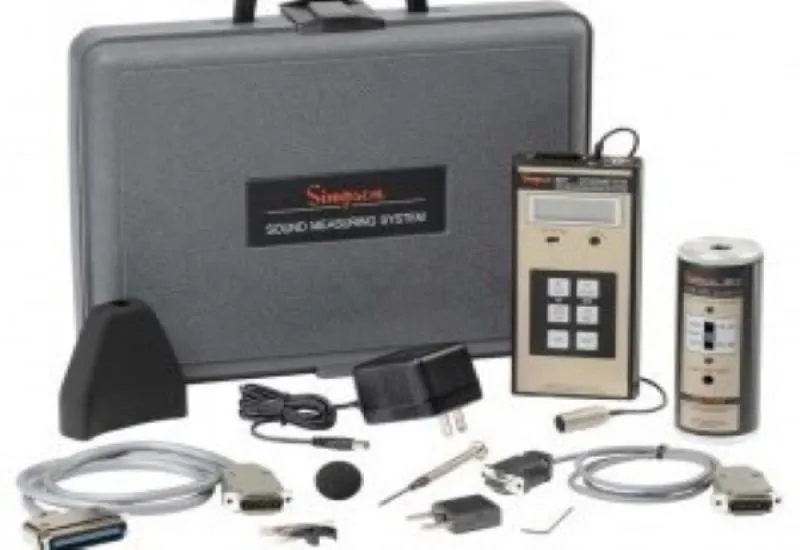
The Simpson Model 893 Noise Dosimeter is an electronic measuring instrument designed to assess cumulative noise exposure in work environments. This type of equipment is part of the instruments used in industrial hygiene, occupational safety and hearing conservation programs, making it possible to determine whether a worker is exposed to sound pressure levels that may cause permanent hearing damage.
The device works as a personal noise dosimeter, that is, a portable system that continuously records the sound pressure level a worker is exposed to during the workday. Unlike conventional sound level meters, this instrument not only measures the instantaneous noise level but also mathematically integrates the acoustic energy received over time to calculate the total sound exposure dose.
The equipment was developed to comply with international acoustic measurement standards and is widely used in noise assessments in manufacturing, construction, mining, power generation, transportation, metallurgical plants and industrial maintenance.
General description
The Simpson Model 893 is a portable measurement system consisting of a microprocessor-based electronic unit, a high-sensitivity electret condenser microphone and an internal digital processing system that records and analyzes the acoustic signal.
During a typical measurement, the instrument is placed on the worker’s belt or clothing while the microphone is positioned near the ear, generally on the shoulder or uniform lapel. This location makes it possible to accurately measure the noise level that actually reaches the person’s auditory system.
The equipment converts the sound pressure fluctuations in the environment into electrical signals via the microphone. These signals are then electronically filtered using A-type frequency weighting, digitized by the data acquisition system and processed by the internal microcontroller to calculate acoustic parameters related to occupational noise exposure.
The ability to record data over long periods allows complete assessments of work shifts, identification of moments of highest exposure and determination of whether permissible exposure limits have been exceeded.
Operating Principle and Interaction
The operation of the Simpson 893 is based on the fundamental principles of ionization and electrostatics. Inside, the instrument houses an air ionization chamber, which acts as the sensing element. This chamber contains a central electrode connected to a reference capacitor and a tiny metallized quartz fiber. Before a measurement, the operator uses a base charger (such as the Simpson 915-0750) to apply a high voltage to the capacitor, which charges the central electrode and the fiber. This charge generates an electrostatic repulsion force between the fiber and the electrode, causing the fiber to move and become visible at the lower end of the viewer scale. When the instrument is exposed to an ionizing radiation field (X-rays or gamma), the photons interact with the chamber walls and with the air molecules inside it, producing the phenomenon of ionization: ion pairs (electrons and positive ions) are created. Under the influence of the electric field generated by the charge on the central electrode, these ions are attracted and drift, partially neutralizing the charge stored in the capacitor. This loss of charge reduces the electrostatic force that kept the fiber separated, allowing the fiber to relax and move toward its rest position. The user, through the eyepiece, observes the position of the fiber’s shadow on a scale graduated in milliroentgens (mR) or roentgens (R). The distance the fiber has traveled from its initial (zero) position is directly proportional to the amount of charge neutralized and, therefore, to the absorbed radiation dose. In this way, the instrument acts as an analog dose integrator, accumulating the effect of radiation over time without requiring any electrical power.
Simpson Model 893 technical data
The design of the instrument meets the accuracy and reliability requirements needed for occupational hygiene assessments.
The sound pressure measurement range is divided into two selectable scales that make it possible to evaluate both moderately noisy environments and industrial settings with high acoustic intensity. The system can operate in approximate ranges of 50 to 100 decibels or 80 to 130 decibels, covering most occupational noise scenarios.
The acoustic sensor is an omnidirectional electret microphone with a frequency response suitable for industrial measurements, able to detect sound signals within an approximate spectrum of 20 Hz to 8 kHz, the range where most of the acoustic energy relevant to human hearing is concentrated.
The equipment applies A-weighting frequency weighting, a method used internationally to represent the sensitivity of the human ear to different frequencies. This feature allows the results to reflect more accurately the real impact of noise on hearing health.
The measurement resolution allows the accumulated dose to be displayed in minimum increments of 0.1 %, while the system can record accumulated exposure values of up to 999.9 %, which facilitates analysis in environments with extremely high noise levels or extended measurement periods.
The instrument also incorporates internal memory capable of storing continuous measurement records for approximately 31 hours, using one-minute logging intervals. This storage capacity allows detailed subsequent analysis of the acoustic behavior of the work environment.
Calculated acoustic parameters
The dosimeter’s internal system processes the acoustic signal and generates various indicators used in occupational hygiene studies, such as those listed below.
The sound pressure level (SPL) represents the instantaneous intensity of the sound measured in decibels. This parameter describes the acoustic level present at a specific moment of the industrial process.
The equivalent sound level (Leq) is an energy-based representation of the average noise over a given period. This value makes it possible to compare different acoustic environments, taking into account both the level and the duration of exposure.
The time-weighted average level (Lavg) describes the average sound pressure during the selected measurement interval, integrating the noise variations present in the environment.
The maximum recorded level (Lmax) indicates the highest sound pressure value detected during the measurement, which is useful for identifying impulsive events or acoustic impacts generated by machinery.
Finally, the instrument calculates the accumulated noise dose, an indicator that represents the percentage of exposure relative to the maximum limit allowed by occupational safety standards.
Construction Details and Metrological Traceability
The heart of the Simpson 893 lies in its optical-electrometer system, a high-precision assembly that includes a metallized quartz fiber only microns thick, illuminated by a small incandescent lamp powered momentarily by a button cell when a side button is pressed. The internal scale, generally engraved with white characters on a black background, has major and minor divisions that, under the magnification of the eyepiece, allow dose estimates with a resolution reaching 2 mR in the first sections of the scale. A critical aspect for the reliability of the instrument is its hermetic ceramic capacitor, whose dielectric stability ensures minimal charge leakage, ensuring that the indicated dose faithfully corresponds to the radiation received and not to internal parasitic discharges. Verification of this characteristic, known as the sealing and leakage test, is a fundamental part of the periodic quality control procedures required by both manufacturers and regulatory bodies . For the calibration of the instrument to be valid in the Mexican regulatory context, it must be performed with standards traceable to those of the National Metrology Center (Centro Nacional de Metrología, CENAM) or to recognized foreign national metrology institutes, ensuring that readings in milliroentgens are comparable and accepted by the authority.
Standards
The design and manufacture of the Simpson Model 893 are governed by international standards that ensure its reliability and accuracy as a measuring instrument. Fundamentally, it meets the requirements set by the International Electrotechnical Commission, specifically in the IEC 60846 standard, which sets guidelines for passive direct-reading dosimeters. This standard specifies criteria for energy response, linearity, repeatability, the effect of orientation (angular dependence) and behavior under various environmental conditions such as temperature and humidity.
ANSI N322: This American National Standards Institute standard is dedicated specifically to direct-reading electroscope-type pocket dosimeters. It defines acceptable accuracy limits, typically within ±10% of the true reading, and sets the maximum allowed self-discharge or capacitor leakage in the absence of radiation, which must not exceed 2% of full scale in 24 hours. It also specifies mechanical construction requirements, including impact resistance and sealing against moisture and dust.
ISO 16637: This more recent international standard specifically addresses monitoring and dosimetry for workers exposed to radiation in emergency or intervention situations. It defines performance requirements for instruments used in extreme conditions where reliability and independence from power sources are critical. The Simpson 893, by virtue of its passive nature and mechanical robustness, finds in this standard an implicit recognition of its suitability for radiological emergency response applications and for environments where electronic equipment could fail.
NOM-011-STPS-2001: Safety and hygiene conditions in workplaces where noise is generated (Mexican workplace noise exposure standard)
NOM-011-STPS-2001 is the main Mexican standard regulating occupational noise exposure. Its purpose is to establish the maximum permissible limits of sound exposure and the safety and hygiene conditions that workplaces must meet in order to protect workers’ hearing health. This standard establishes that any company where noise levels capable of affecting hearing health are generated must carry out periodic acoustic assessments and apply control measures when levels exceed the established values.
Maximum permissible exposure limits
The standard defines a relationship between the noise level (in dB A) and the maximum permissible exposure time during a workday. These values are fundamental for determining the noise dose a worker receives.
Noise level — Maximum exposure time:
-
90 dB(A) → 8 hours
-
93 dB(A) → 4 hours
-
96 dB(A) → 2 hours
-
99 dB(A) → 1 hour
-
102 dB(A) → 30 minutes
-
105 dB(A) → 15 minutes
When the sound level falls between two values in the table, the standard provides a formula for calculating the Maximum Permissible Exposure Time (TMPE) using a 3 dB exchange rate.
Uses of the dosimeter in industrial hygiene
Noise dosimeters such as the Simpson Model 893 are fundamental tools for assessing acoustic risks in industrial environments. Their use makes it possible to determine workers’ actual exposure throughout their workday, identify processes that generate hazardous noise levels and develop control strategies to reduce acoustic impact.
In industrial plants it is used to analyze production lines, rotating machinery, ventilation systems, compressors, turbines and mechanical impact equipment. In the construction industry it can be used to evaluate exposure generated by pneumatic hammers, drills, generators and heavy machinery.
It is also used in occupational safety audits, industrial noise impact studies, hearing protection programs and regulatory compliance assessments before labor authorities.
Importance of the dosimeter in preventing hearing loss
Prolonged exposure to high noise levels can cause noise-induced hearing loss, an irreversible condition that affects millions of workers worldwide. Because hearing damage usually develops gradually, accurate noise measurement is essential for implementing prevention strategies.
Instruments such as the Simpson Model 893 Noise Dosimeter make it possible to turn ambient noise into quantifiable data that facilitates risk assessment, the implementation of control measures and verification of compliance with occupational safety standards.
Thanks to its ability to record each worker’s actual sound exposure, this type of equipment has become an essential tool in modern industrial hygiene and occupational health protection programs.
Need Advice or a Quote?
Contact us today on WhatsApp at 8117860768 for pricing, availability and usage recommendations. At Creativeit Group, our specialized technical team can help you integrate it into your measurement processes.