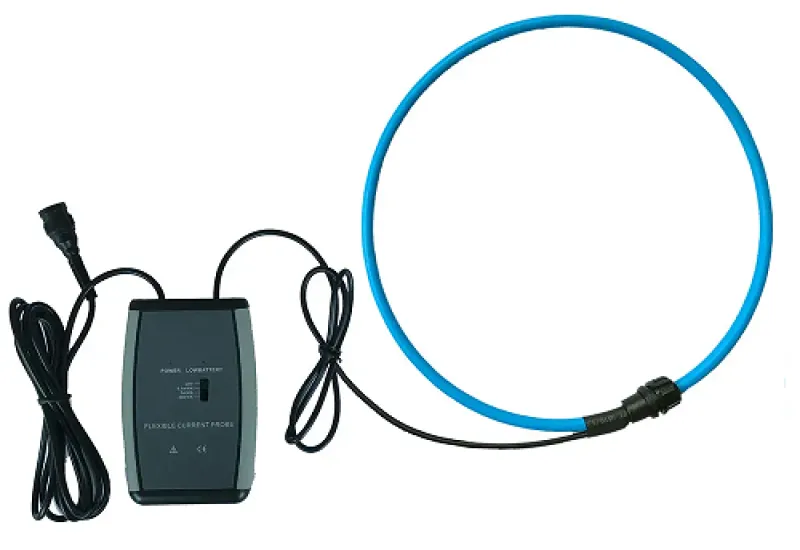
A Rogowski current probe is a type of sensor used to measure alternating electrical current (AC) without direct contact with the conductor. It is especially useful for measuring high, transient, or harmonic currents in electrical systems.
It is very useful in applications that require accurate measurement, without direct contact with the conductor and without opening the circuit.
What is it and how does it work?
The Rogowski probe consists of a coil of wire wound into a loop (usually flexible), which is placed around the conductor carrying the current.
It does not measure the current directly; instead, it detects the magnetic field generated by that current. From that field, the probe generates a voltage signal proportional to the rate of change of the current, which is electronically integrated to obtain the actual current.
What is a Rogowski probe used for?
Measuring alternating current (AC)
- On power lines, transformers, motors, inverters, etc.
- Ideal for high, rapidly changing, or transient currents.
Power quality analysis
- Used together with analyzers to view harmonics, distortion, current peaks, etc.
Measurement in large installations
- Very useful in electrical panels, substations, or wherever there are many thick cables.
Portable applications
- Being flexible, lightweight, and non-invasive, it is ideal for mobile or temporary test setups.
Key features:
- Non-intrusive: There is no need to disconnect the cable to measure.
- Flexible: Fits into tight or hard-to-reach places.
- Lightweight: Much lighter than a conventional current transformer.
- Accurate for high currents: Ideal for measuring thousands of amperes.
- Does not saturate: Unlike current transformers with an iron core.
- Measures high frequencies: Useful in harmonic or power quality analysis.
|
Feature |
Rogowski probe |
|
No direct contact required |
✅ |
|
Flexible and lightweight |
✅ |
|
Measures very high currents |
✅ (up to thousands of amperes) |
|
No iron core (no saturation) |
✅ |
|
Measures complex waveforms |
✅ |
Where is it commonly used?
- Industrial facilities
- Renewable energy (solar, wind)
- Temporary or maintenance measurement
- Data centers
- Electrical research and development
Rogowski Current Probe
Technical data
Model specification
|
Coil length |
950mm |
|
Coil inner diameter. |
Φ 300mm |
|
Weight |
120g |
Technical specification
|
Function |
AC leakage current test, high current, high harmonic current, complex waveform current, inrush transient current, phase, power, |
|
Test mode |
Flexible CT: the output signal is the time derivative of the current. By integrating the output voltage signal, the input current |
|
Coil diameter |
Φ 8mm |
|
Range |
0A ~ 10kA |
|
Resolution |
0.1A |
|
Output |
0.3mV/A 3mV/A 30mV/A third gear (can be customized for 0-5V, 4-20mA, etc.) |
|
Power supply |
9V 6F22 battery |
|
Low battery indication |
Yes |
|
Power consumption |
6 mA at voltage output; one alkaline dry battery is expected to power it continuously for 80 hours |
|
Accuracy level |
± 1.0% FS (50Hz/60Hz); 23 ℃ ± 2 ℃, below 70% RH, the cable is at the center of the coil) |
|
Phase error |
≤ 1 °(50Hz/60Hz;23 ℃ ± 2 ℃) |
|
Initial phase |
90° |
|
Output interface |
BNC connector (audio plug, banana connector, or bare wire optional) |
|
Output cable length |
2M |
|
Electric field interference |
No hysteresis effect, no external electric field interference |
|
Cable position |
The cable under test is at the center of the coil, and position error affects ≤ ± 0.3% FS |
|
Frequency response |
0.1Hz ~ 10MHz |
|
Line voltage |
Tested below AC 1000V |
|
Operating temperature and humidity |
-20 ℃ ~ 50 ℃; below 80% Rh |
|
Storage temperature and humidity |
-10 ℃ ~ 60 ℃; below 70% Rh |
|
Insulation strength |
AC 2000V/RMS (both ends of the coil) |
|
Suitable for safety regulations |
Pollution degree 2, CAT IV 1000V, 1, 1, 2, 1, 2, 2 |