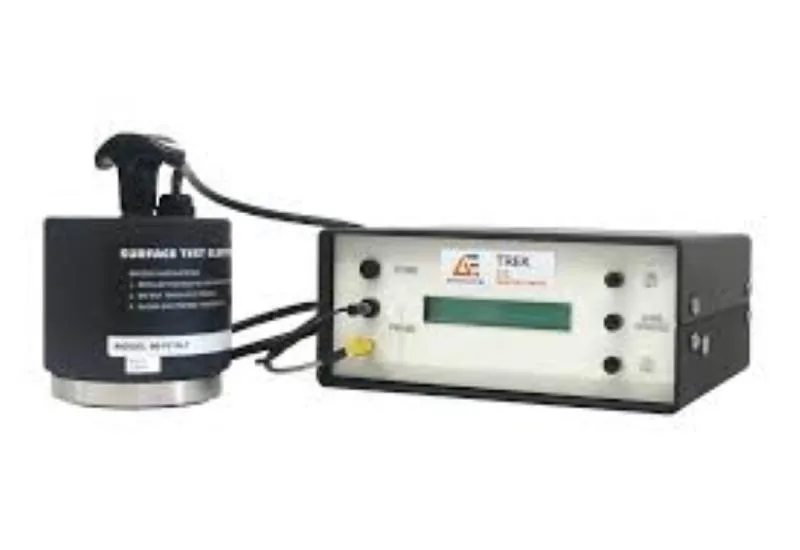
The cost of a static failure can be very high; the price of preventing it is within reach of a single instrument.
Did you know that a surface that appears ‘safe’ could be generating discharges capable of destroying sensitive electronic components without you realizing it? Yes, and that is why the Monroe Electronics 272A exists. Many seemingly harmless materials can fall in the insulator range, accumulating charge to dangerous levels. This meter doesn’t just tell you whether a surface is conductive, dissipative or insulative; it gives you the numerical, scientific certainty to certify that your work environment is truly protected. Because in static control, what isn’t measured can’t be controlled.
Electrostatic discharge can cause:
-
Immediate damage to electronic components
-
Intermittent failures that are difficult to diagnose
-
Loss of reliability in finished products
-
Rejections in quality audits
-
Increased warranty costs
The Monroe Electronics 272A is a high-precision measuring instrument designed to evaluate the electrostatic properties of materials. It is the definitive tool for professionals who need to verify that their surfaces, floors and packaging meet the ANSI/ESD STM11.11, ASTM D-257 (using the Monroe 96101A-1 electrode included with the instrument) and EIA-541 standards.
ANSI/ESD STM11.11 – Surface Resistance Measurement of Static Dissipative Planar Materials
An ESD Association standard for measuring the surface resistance of ESD (electrostatic) dissipative materials using concentric electrodes such as those of the guard probe. It is widely used for electrostatic discharge control in electronic products and materials.
EIA-541 — Packaging Material Standards for ESD Sensitive Items
The EIA-541 standard, developed by the Electronic Industries Alliance, establishes test methods for evaluating the electrical properties of packaging materials intended to protect electrostatic discharge sensitive devices (ESDS). To comply with the standard, measurements must be made exclusively with concentric electrodes (center electrode and guard ring), since this configuration ensures a controlled electric field and technically valid results. It is worth noting that our laboratory has calibrated concentric electrodes suitable for performing these tests, which allows evaluations in accordance with the technical requirements established in EIA-541.
ASTM D257 – Measurement of Resistance and Resistivity in Insulating Materials
This is an international standard that establishes the test method for determining DC electrical resistance and the surface and volume resistivity of solid insulating materials such as plastics, resins, coatings and composites. The procedure defines the use of a controlled DC voltage, specific electrification times (commonly 60 seconds) and guarded-ring electrodes to minimize leakage currents and ensure accurate, reproducible measurements. It also requires documenting environmental conditions such as temperature and humidity, since these significantly influence the results. This standard does not set acceptance limits; instead, it provides a standardized method for obtaining comparable and technically valid values in the laboratory or in industrial quality control.
Using a certified meter such as the 272A makes it possible to validate that:
-
Conductive floors meet specification
-
Dissipative mats maintain adequate resistance
-
Workbenches are within the regulatory range
-
Grounding systems work correctly
Its portable design and ease of use make it the ideal instrument for quality control, process engineering and maintenance in industries such as electronics, pharmaceuticals, aerospace and the manufacture of sensitive components.
Main Features
-
Dual Function: Measures both Surface Resistivity (Ω/□) and Resistance to Ground (Ω) with a single instrument.
-
Portable and Rugged: Its compact size and built-in rechargeable battery allow use in the laboratory or on the plant floor without depending on mains power.
-
Voltage Selection: Offers the option of choosing between 10V and 100V, allowing low- and high-resistance materials to be tested according to the specific application.
-
High Accuracy: Capable of reading everything from conductive materials to insulators, covering a wide measurement range.
-
Easy Reading: Clear digital display that shows results in scientific or logarithmic notation for quick interpretation.
-
Auto-Ranging: The instrument automatically selects the correct scale, simplifying the measurement process.
Functions
1. Surface Resistivity Measurement: Determines the ability of a surface to dissipate electrostatic charge, expressed in ohms per square (Ω/sq).
2. Point-to-Point Measurement (Rtt): Evaluates the electrical resistance between two points on a material.
3. Resistance-to-Ground Measurement (Rg): Determines the resistance from a surface to the grounding system.
Technical Specifications
| Parameter | Value |
|---|---|
| Surface Resistivity Range | 8×10⁴ to 2.0×10¹⁴ Ω/□ |
| Resistance to Ground Range | 8×10³ to 2.0×10¹³ Ω |
| Test Voltages | 10V and 100V (manually selectable) |
| Accuracy | ±5% (typical) |
| Display | Digital LCD, 3½ digits |
| Power | Internal rechargeable battery (Ni-Cd) |
| Battery Life | Up to 8 hours of continuous use |
| Included Electrode | Monroe 96101A-1 |
| Dimensions (Meter) | 6.4 cm x 15.2 cm x 15.2 cm |
| Electrode Weight | Approx. 2.3 kg (5 lbs) |
Accessories
Model 96101A-1 — Guarded-Ring Measurement Electrode
This is the main accessory included with the 272A, and it is the one that enables measurement of fundamental quantities such as surface and volume resistivity in accordance with standardized methodologies such as ASTM D257 and ESD resistivity testing requirements.
Main Features
-
Concentric “guarded-ring” design:
The electrode consists of two concentric elements — an outer ring and an inner disc — that force the current through a well-defined area of the sample to obtain reliable resistivity measurements. -
ASTM D257 conformity:
Its geometry and construction are specifically designed to comply with the surface and volume resistivity measurement methods described in the ASTM D-257 standard, which gives the measurements metrological validity when the proper procedures are followed. -
Suitable for flat surfaces:
It is used on flat materials such as ESD floors, dissipative mats, coatings or laminates. The surface must fully cover the area of the outer ring to ensure correct measurements. -
Dimensions:
The outer ring has an inner diameter of approximately 6.4 cm and the inner disc about 3.2 cm, providing a measurement area suitable for industrial materials
How It Works
The meter applies a DC voltage (10 V or 100 V depending on the expected range) between the ring and the inner disc; the current flowing between the two through the material is converted into a resistivity value that the instrument automatically calculates and displays.
Model 96163 — Point-to-Point Probe
The 96163 accessory is a specialized probe for measuring resistance between two specific points on a part or surface, which cannot be done directly with the standard ring electrode.
Features and Use
-
Designed for irregular or specific objects:
It allows measurement of the electrical resistance between two localized points on non-flat parts — for example, tubes, brackets, thermoformed plastics or surfaces where a ring electrode cannot be applied. -
Electrodes with resilient contact:
The probe uses two spring-loaded contacts with conductive elastomer faces, which helps maintain good contact with the measured surface, even if it is slightly curved or irregular. -
Usage precautions:
Moderate pressure should be applied to ensure contact without deforming the contacts. It is also cautioned that the contacts must not be touched with the body while voltage is applied. -
Maintenance:
The conductive elastomer surface can become contaminated with residue; this can affect low-resistance readings. Cleaning with isopropyl alcohol is recommended when necessary.
Model 96164 — Miniature Point-to-Point Probe
The 96164 is another point-to-point probe, but with smaller contacts for applications where the measurement points are very close together or on small surfaces.
Although this model does not appear as a main accessory in the 272A documentation, it is commonly referred to as a miniature resistance probe compatible with Monroe resistivity/resistance measuring equipment.
Specific Use
-
Measurements in small areas or confined spaces:
Its compact size makes it useful for evaluating resistances on very small parts, narrow coating areas, individual components, circuits or narrow substrates where a larger probe would not fit. -
Narrow contact design:
It allows the two measured points to be brought close together without geometric interference — ideal for measurements on ESD components that are not easy to test with a larger tool.
Why Choose the Monroe Electronics 272A?
In professional ESD programs, you can’t improvise. The Monroe 272A offers:
-
Reliable accuracy
-
Standards compliance
-
Industrial portability
-
Reproducible results
It is a strategic investment for any company that handles sensitive electronic components or requires ESD certification.
Need Advice or a Quote?
Contact us today on WhatsApp at 8117860768 for pricing, availability and usage recommendations. At Creativeit Group, our specialized technical team can help you integrate it into your resistive measurement processes.