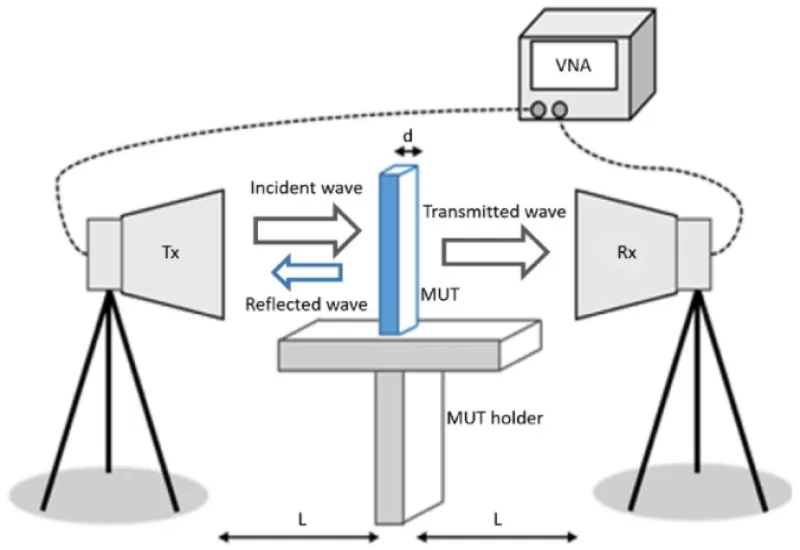
Dielectric characterization of materials is a fundamental process in the development of electronic products, telecommunications, composite materials and high-frequency applications. The free space method measures electromagnetic properties without direct physical contact with the sample, reducing errors associated with fixtures or invasive sample preparation.
Our permittivity measurement service using the free space method and N1500A software is aimed at manufacturers, R&D laboratories, RF integrators and industrial sectors that need to validate the electromagnetic behavior of materials in the microwave and radio frequency ranges.
What Is Dielectric Permittivity?
Relative permittivity determines how a material interacts with an electric field.
ε = ε′−jε′′
This parameter makes it possible to analyze:
- electrical energy storage
- dielectric losses
- electromagnetic absorption
- RF behavior
- performance in antennas and radomes
- microwave response
The real part describes the material’s polarization capability, while the imaginary part represents dielectric losses.
How Does the Free Space Method Work?
The free space method uses transmitting and receiving antennas to propagate electromagnetic waves through the material under test.
The system analyzes:
- transmission
- reflection
- attenuation
- phase shift
From these parameters, the following are calculated:
- complex permittivity
- permeability
- loss tangent
- dielectric coefficients
The technique is ideal for:
- flat materials
- sheets
- foams
- composites
- RF absorbing materials
- engineering plastics
- coatings
- automotive materials
Advantages of the Free Space Method
- Non-destructive measurement
- No direct electrical contact
- High repeatability
- Evaluation over a wide frequency range
- Compatible with large or irregular materials
- Fewer fixture-related errors
- Ideal for RF and microwave applications
Using the N1500A Software
The N1500A software automates and processes advanced electromagnetic property measurements using vector network analyzers (VNAs).
The system performs:
- specialized calibration
- S-parameter processing
- error compensation
- dielectric property extraction
- technical report generation
This delivers reliable results for industrial and research applications.
Common Applications
- RF materials development
- Radome validation
- Antenna design
- EMC absorbing materials
- Automotive electronics
- Telecommunications
- Aerospace
- High-frequency PCBs
- Composite materials
- University research
- Validation of engineering polymers
Service Benefits
- Accurate material characterization
- Validation for RF design
- Reduced development risk
- Support for electromagnetic simulation
- EMC performance optimization
- Data useful for certification and validation
Technical Capabilities
| Parameter | Typical capability |
|---|---|
| Method | Free Space |
| Software | N1500A |
| Instrumentation | VNA |
| Measured parameters | Permittivity and losses |
| Sample type | Flat, solid materials |
| Application | RF and microwave |
Related Services
- S-parameter measurement
- RF materials characterization
- EMC validation
- Electromagnetic absorption measurement
- Dielectric loss evaluation
- Analysis of materials for antennas
- Development of microwave materials