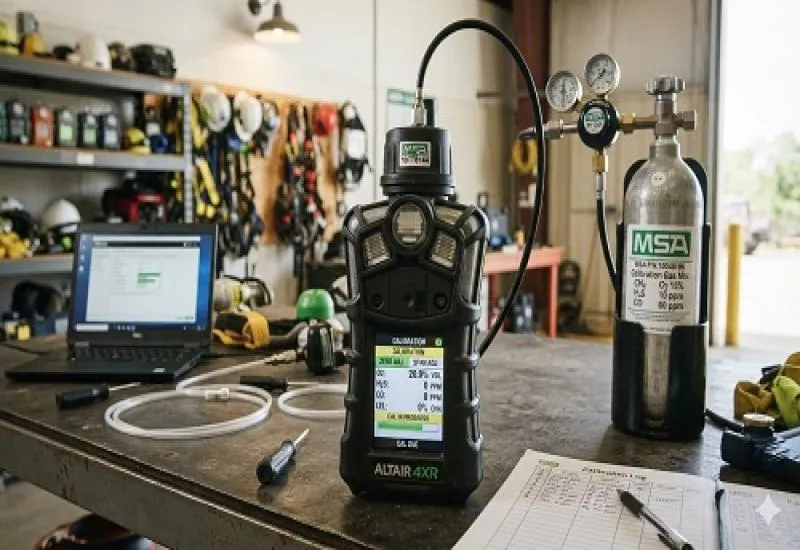
Calibration Service for the MSA ALTAIR 4XR Multigas Detector
MSA ALTAIR 4XR calibration is a technical procedure intended to verify and adjust the response of the sensors installed in this portable multigas detector. The service checks the behavior of the instrument using known concentrations of reference gases and establishes whether its readings fall within the corresponding acceptance criteria.
The MSA ALTAIR 4XR is used in various industrial activities where it is necessary to know the atmospheric conditions of a work area. Depending on the instrument configuration, it can take measurements of oxygen, combustible gases and toxic gases. Because of the importance of these measurements, keeping the detector in a calibration, verification and maintenance program is essential for organizations that use this equipment.
Over time, sensors can show changes in response due to aging, exposure to contaminants, environmental conditions, storage or frequent use. A calibration evaluates these variations and, when appropriate, makes the adjustments needed to restore the instrument’s expected response.
What Is MSA ALTAIR 4XR Calibration?
Calibration consists of comparing the response indicated by the detector against a known concentration used as a reference. The goal is to determine how close the instrument’s reading is to the reference value and to make an adjustment when the applicable procedure requires it.
To perform this work correctly, the specific configuration of the ALTAIR 4XR must be identified. The installed sensors can vary between units, so the gases used during calibration must correspond to the measurement channels present in each detector.
During the service, the application of the reference gas is controlled and the instrument’s response is observed. Results can be recorded before and after adjustment to document the behavior of the equipment.
Calibration should not be considered merely an electronic adjustment. It is a verification process of the measurement system that requires identifying the instrument, reviewing its operating condition and using appropriate references for the installed sensors.
Initial Verification of the ALTAIR 4XR Detector
Before the calibration gases are applied, a general evaluation of the equipment is performed. This review identifies possible conditions that could affect the result of the procedure.
The physical condition of the detector, display, buttons,
housing, sensor inlets, battery and general operation are checked. The instrument configuration is also reviewed to determine which sensors are installed and which must be included in the procedure.
This step is important because a physical or functional problem can produce incorrect results. For example, a blocked sensor inlet, a low battery or a deteriorated sensor can affect the response during gas application.
Once the initial conditions are confirmed, the corresponding tests proceed.
Calibration of the ALTAIR 4XR Sensors
The ALTAIR 4XR configuration can include different sensors depending on the application for which the equipment was purchased. For this reason, calibration must take into account the specific configuration of each unit.
For the oxygen channel, an appropriate reference is used to check the sensor’s response. For the channels intended for toxic gases, reference gases corresponding to the installed sensor are used. The combustible gas sensor also requires a specific procedure according to the instrument configuration and the selected reference gas.
During controlled gas application, the reading displayed by the ALTAIR 4XR is observed. The result is compared with the known value of the reference used.
If the response is outside the established criteria, a calibration adjustment may be necessary. After the adjustment, a new check is performed to determine the sensor’s final response.
Difference Between Calibration and Bump Test
One of the most important concepts in gas detector maintenance is distinguishing between calibration and a bump test.
A bump test is a quick functional test that confirms the detector responds when exposed to a known gas. During this test it can also be verified that the alarm systems work correctly.
Calibration has a different purpose. In this procedure, the instrument’s indication is compared with a known concentration and, when appropriate, an adjustment is made to correct the sensor’s response.
Therefore, a detector that passes a bump test has not necessarily been calibrated. Both activities can be part of a multigas detector’s maintenance program, but they serve different functions.
Reference Gases for Calibration
Selecting the reference gas is a critical aspect of the procedure. The reference used must be compatible with the sensors installed in the ALTAIR 4XR and have the appropriate concentration for the procedure.
Gas cylinders must be correctly identified and their information retained as part of the service records. In a metrological control system, it is advisable to record the identification of the gas used and the available information on its concentration and traceability.
Gas must be applied using an appropriate system to avoid losses, contamination or conditions that could affect the test.
When Should an ALTAIR 4XR Be Calibrated?
Calibration frequency should be set taking into account the manufacturer’s instructions, operating conditions and each organization’s internal procedures.
In addition to scheduled calibrations, it may be necessary to evaluate the instrument after significant gas exposure, after a repair, when a sensor is replaced or when the detector gives unexpected readings.
A check may also be advisable when there is an obvious difference between the instrument’s reading and the known atmospheric conditions.
A maintenance program makes it possible to identify in a timely way which instruments need calibration, inspection or sensor replacement.
Metrological Control of Gas Detectors
Companies that use multiple detectors can establish a metrological control program to keep their instruments identified.
Each ALTAIR 4XR can be linked to its serial number, sensor configuration, calibration history, results obtained and maintenance dates.
This information simplifies equipment management and shows which units are available for operation and which are pending maintenance or calibration.
The history can also be used to analyze the detector’s behavior over time and determine whether there is a trend that requires attention.
Service Documentation
Documentation is an important part of the calibration process. A technical record can include the detector identification, model, serial number, installed sensors, calibration date, reference gases used and results obtained.
Initial conditions, adjustments made and post-calibration results can also be recorded.
This information provides evidence of the work performed and makes it easier to track the instrument within the company’s quality system.
Professional ALTAIR 4XR Calibration Service
We offer calibration service for the MSA ALTAIR 4XR, aimed at companies that need to keep their multigas detectors under a verification and maintenance program.
The service can be adapted to individual units or to groups of detectors belonging to the same organization. Each instrument is evaluated according to its configuration and application.
To request information, you can provide the equipment model, serial number and sensor configuration. With these details we can determine the required procedure and establish the service conditions.
MSA ALTAIR 4XR calibration keeps a technical record of the detector’s performance and supports instrument control programs used in industrial environments.