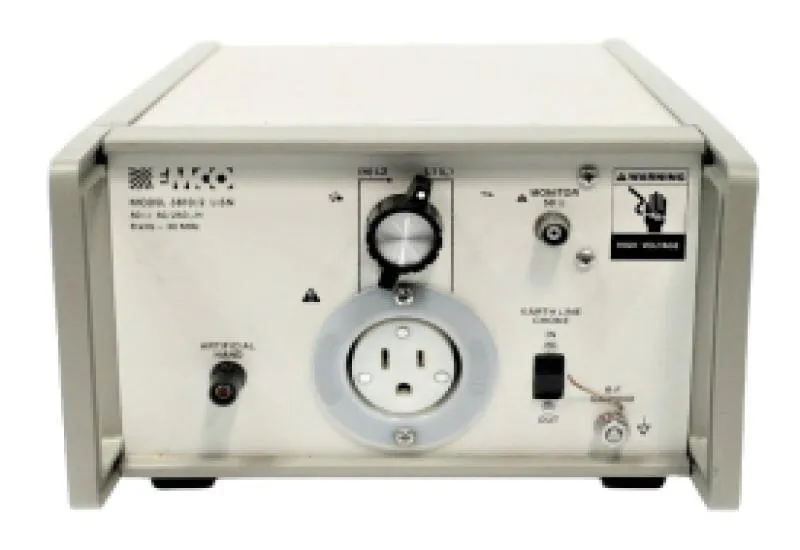
To evaluate conducted electromagnetic interference in a reproducible way, tests must be performed under controlled line impedance conditions. In this context, line impedance stabilization networks (LISNs) play a fundamental role by providing a standardized impedance and a defined measurement point for the analysis of radio-frequency signals. Under standards such as IEC CISPR 22 (equivalent to EN55022) and regulations such as FCC Part 15, the use of a LISN is mandatory for evaluating conducted emissions on mains-connected equipment.
EMCO 3810 technical specifications
| Parameter | Specification |
|---|---|
| Equipment type | LISN (Line Impedance Stabilization Network) |
| Models | 3810/2 and 3816/2 |
| Frequency range | 9 kHz to 30 MHz |
| Main function | Impedance stabilization and RF coupling |
| RF output impedance | 50 ohm |
| Application | Conducted emissions measurement |
| Installation | Between the power mains and the equipment under test (EUT) |
| Safety standard | Per IEC 61010 |
| Additional certification | CSA (Canadian Standards Association) |
| Compatibility | Spectrum analyzers / EMI receivers |
| Measurement standards | FCC Part 15, VDE 0871, VDE 0875, EN55022 |
As a differentiator, the EMCO 3810 not only enables accurate measurement of conducted emissions by stabilizing the line impedance, but also supports predictive analysis of the radiated behavior of the equipment under test. This capability is particularly useful in diagnostic and precompliance stages, where the correlation between conducted and radiated emissions makes it possible to identify interference sources without immediately resorting to anechoic chambers or fully certified test sites.
Applications in EMC testing and the industrial environment of northeastern Mexico
The EMCO 3810 LISN is essential in electromagnetic validation activities within the design, integration, and manufacturing of electrical and electronic equipment. In the industrial context of northeastern Mexico, where sectors such as automotive, home appliances, telecommunications, and power electronics converge, conducted emissions testing is an integral part of the requirements for marketing products in both domestic and international markets.
In precompliance applications, the LISN lets manufacturers evaluate the EMI performance of their products before sending them to accredited laboratories, reducing the risk of nonconformity and the costs associated with redesigns. Equipment such as switch-mode power supplies, UPS systems, variable frequency drives, and industrial controllers are typical candidates for this type of testing, and must comply with standards such as IEC CISPR 32 (successor to EN55022), as well as FCC Part 15 regulations for access to the U.S. market.
The LISN is installed between the power supply mains and the equipment under test (EUT), providing a known impedance and isolating the measurement from interference coming from the line. This keeps measurements taken with spectrum analyzers or EMI receivers consistent and comparable with the regulatory limits. In addition, its use helps identify noise modes (common-mode and differential-mode), which is key to implementing effective mitigation strategies such as redesigning EMI filters or optimizing current return paths.
In engineering and validation environments, the EMCO 3810 is also used as a diagnostic tool to correlate conducted emissions with possible electromagnetic radiation problems, allowing a more efficient approach to regulatory compliance without relying exclusively on open-area testing or specialized chambers.
Contact for rental and service
To rent the EMCO 3810, or to receive technical advice on implementing conducted emissions tests, integration with spectrum analyzers, or EMC precompliance strategies, please get in touch by sending a WhatsApp message to the number shown on the page. Through this channel we provide information on availability, service terms, and additional technical specifications tailored to your project’s requirements.