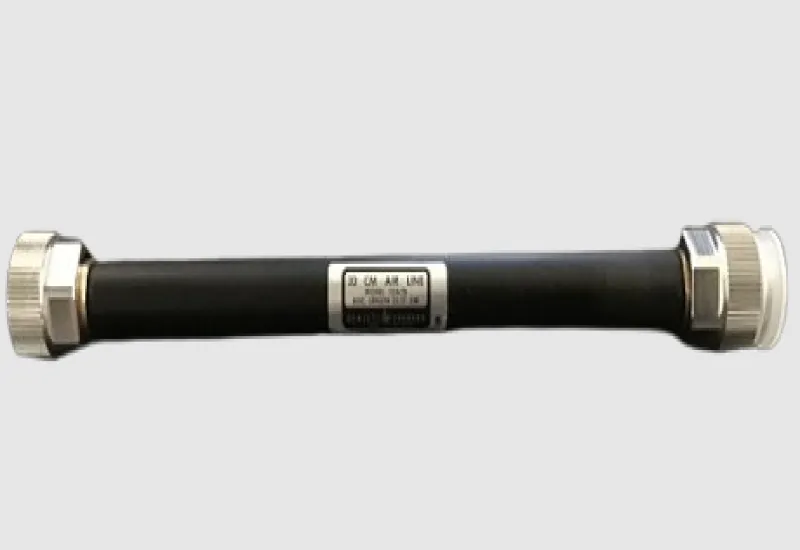
The HP 11567A Air Line Extension is a precision transmission line element used for verifying, calibrating and diagnosing RF and microwave measurement systems. Thanks to its coaxial air-dielectric geometry and APC-7 connectors with high mechanical repeatability, this extension introduces a precisely known, stable electrical length into a test setup.
In RF metrology environments, calibration laboratories and VNA validation, a precision air line is especially useful for verifying phase stability, tracking and the mechanical behavior of RF interconnects. Its low reflection and excellent stability make it a key tool for detecting errors that normally go unnoticed in conventional testing.
What Is a Precision Air Line?
An “air line” is a coaxial line designed with an air dielectric instead of solid materials. This configuration significantly reduces:
- dielectric losses
- dispersion
- impedance variations
- thermal and mechanical effects
The result is an extremely stable and predictable transmission line, ideal for RF calibration and metrological verification.
The HP 11567A works as a 50 Ω coaxial extension with known phase behavior, allowing controlled electrical offsets to be introduced in high-frequency measurements.
Phase Error Verification in VNAs
The most important application of the HP 11567A is the functional verification of vector network analyzers (VNAs).
Inserting a known length between the VNA and the DUT produces a perfectly predictable phase shift.
This makes it possible to verify:
- VNA phase linearity
- tracking stability
- channel-to-channel coherence
- reference plane accuracy
- measurement repeatability
- time stability of the RF system
With approximately 20 cm of electrical length, the 11567A introduces a considerable phase rotation even at relatively low frequencies, making it easier to identify deviations or anomalies in S-parameter measurements.
APC-7 Mechanical Reference Standard
The APC-7 connector was developed specifically for precision metrology applications and offers important advantages over conventional Type N or SMA connectors.
Thanks to its excellent concentricity and mechanical repeatability, the HP 11567A also serves as a reference for evaluating the physical condition of RF interconnects.
Mechanical Diagnostic Applications
- Validation of RF connector wear
- Identification of poor concentricity
- Detection of torque problems
- Evaluation of connection repeatability
- Diagnosis of dirt or mechanical deformation
If measurements change excessively after reconnecting the air line, the problem usually does not come from the DUT, but from:
- damaged connectors
- mechanical contamination
- deformations
- unstable RF interfaces
Main Features
- Precision coaxial air-dielectric line
- Controlled 50 Ω impedance
- Low reflection and excellent stability
- APC-7 connectors with high repeatability
- Ideal for phase verification and RF calibration
- Compatible with measurements up to 18 GHz
- Excellent performance for RF metrology laboratories
Technical Specifications
| Parameter | HP 11567A |
|---|---|
| Impedance | 50 Ω |
| Frequency range | DC to 18 GHz |
| Reflection coefficient | 0.018 + (0.001 × frequency in GHz) |
| Connector | APC-7 |
| Length | 20.21 cm (8 in.) |
| Line type | Coaxial air line |
| Approximate weight | 0.45 kg |
Industrial and Laboratory Applications
- Functional verification of VNAs
- Phase stability validation
- Diagnosis of RF tracking errors
- Connector repeatability evaluation
- Calibration of microwave measurement systems
- EMC and RF laboratories
- Integration of automated test systems
- Precision RF metrology
Benefits of Renting the HP 11567A
Renting a precision air line gives you access to specialized metrology instrumentation without a large investment in rarely used assets.
Operational Advantages
- Lower calibration and diagnostic costs
- Immediate availability for RF troubleshooting
- Quick validation of VNAs and test benches
- Preventive diagnosis of connectors and adapters
- Support for audits and technical verifications
- Ideal for temporary projects or specific validations
When Should You Use a Precision Air Line?
An air line extension is especially recommended when:
- there are doubts about phase stability
- inconsistent variations appear in S-parameter measurements
- mechanical problems in RF connectors are suspected
- tracking between ports needs to be validated
- high-precision calibrations or metrological verifications are being performed
In RF and microwave applications, many measurement deviations do not come from the DUT, but from mechanical or reference problems in the interconnect system. A precision air line makes it possible to quickly isolate this type of error.