Brief Description
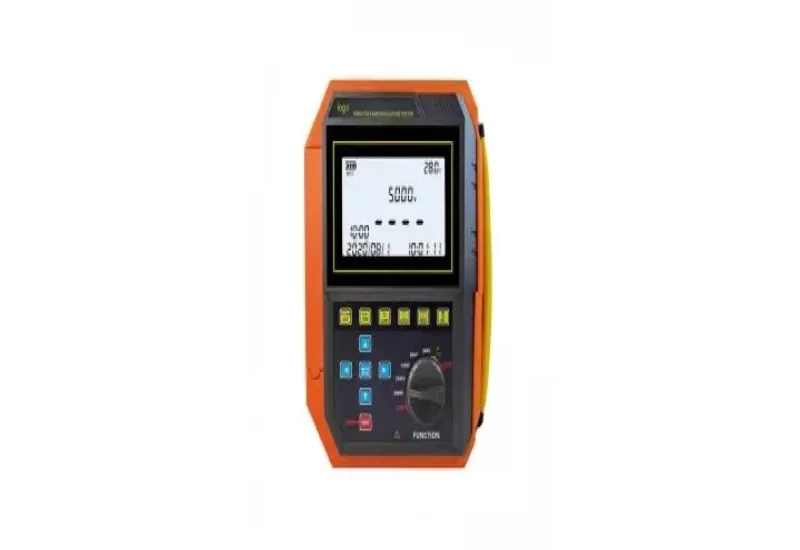
The Insulation Resistance Tester, also known as a megohmmeter or high-voltage megohmmeter, is a device used to perform insulation tests on electrical materials and equipment. This instrument is essential for verifying the integrity of insulating materials and preventing potential electrical failures.
The digital insulation resistance meter consists of advanced integrated circuits that include a high-precision micro-current measurement system, a digital boost system and an automatic discharge circuit. Simply by connecting it to the device under test (DUT) with a high-voltage lead and a signal lead, you can measure insulation resistance with ease.
Its features include a nominal output test voltage range of 250 V to 5000 V and an insulation resistance measurement range of 0.01 MΩ to 5.00 TΩ. It can also measure DC voltages from 0 V to 1000 V and AC voltages from 0 V to 750 V. It is particularly useful for testing transformers, motors, cables and other electrical equipment, both in laboratory settings and at the job site.
Technical specifications
Insulation resistance measurement range and accuracy
| Output voltage | Measurement range | Accuracy |
| 250V(15%)DC |
0.01MΩ~2.50GΩ 2.50GΩ~250 GΩ |
±3%rdg±5dgt ±15%rdg±5dgt |
| 500V(10%)DC |
0.01MΩ~5.00GΩ ±3%rdg±5dgt |
±3%rdg±5dgt ±15%rdg±5dgt |
| 1000V(10%)DC |
0.01MΩ~10.00GΩ 10.00GΩ~1.00 TΩ |
±3%rdg±5dgt ±15%rdg±5dgt |
| 2500V(10%)DC |
0.01MΩ~25.0GΩ 25.0GΩ~2.50 TΩ |
±3%rdg±5dgt ±15%rdg±5dgt |
| 5000V(10%)DC |
0.01MΩ~50.0GΩ 50.0GΩ~5.00 TΩ |
±3%rdg±5dgt ±15%rdg±5dgt |