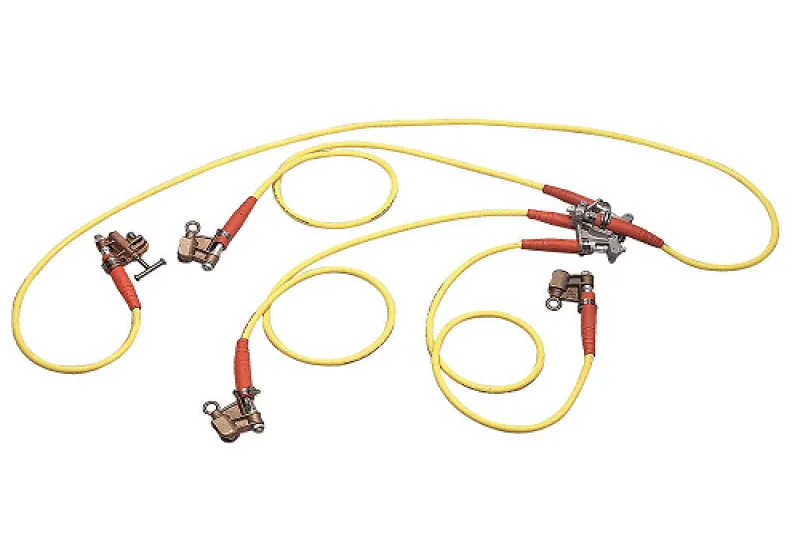
The grounding set (also known as a portable grounding kit) is a set of personal and collective protective elements used in electrical work to discharge the residual or accidental energy of an electrical system to ground, preventing electrocution or accidents from unexpected re-energization
What is a grounding set?
It is a set designed to protect personnel working on de-energized electrical systems that could nonetheless:
- Receive power by mistake (reclosing).
- Hold residual inductive or capacitive energy.
- Have voltages transferred from other lines.
This kit closes the circuit to ground, diverting any dangerous current.
What does a grounding set include?
|
Component |
Function |
|
Connection clamps |
Attach to the conductors of the line or equipment to be protected. |
|
Conductor cable |
Flexible copper with tough insulation (yellow or orange). |
|
“Y” or “U” type connector |
Joins several clamps to the same grounding point. |
|
Ground clamp |
Connects to the ground bar or ground rod. |
|
Bag or case |
For transporting and protecting the equipment. |
How is it installed?
- Verify that the system is de-energized (with a voltage detector).
- First connect the ground clamp to ground.
- Then connect the clamps to the conductors (phase by phase).
- Confirm that all phases are bonded to ground.
- Carry out the electrical work safely.
Why is it important?
- Prevents the human body from being the path to ground.
- Discharges residual or induced voltages.
- Protects in case of accidental re-energization or human error.
- Mandatory in many safe work protocols (per standards such as OSHA, NFPA 70E, IEC 61230).
How do you choose the right set?
It depends on:
- System voltage level (13.2 kV, 34.5 kV, 115 kV, etc.).
- Expected short-circuit current (dissipation capacity).
- Fault clearing time.
- Length and type of cables.
- Applicable regulations (NOM, IEC, ANSI, etc.).
The grounding set is a vital protection system used to ensure that electrical equipment is properly discharged to ground during maintenance work, avoiding electrocution risks from residual voltages or accidental reconnection