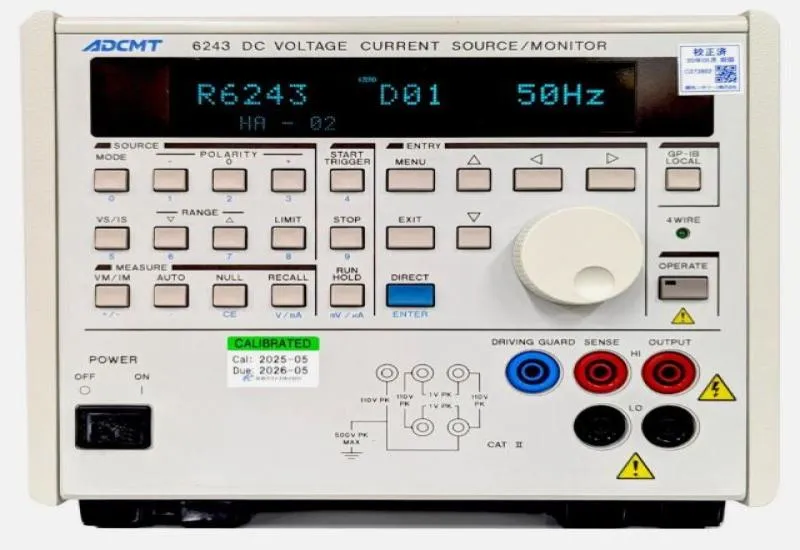
DC Voltage and Current Source/Monitor for High-Precision Electrical Characterization
At Creativeit we offer specialized services for electrical measurement, characterization and evaluation using the ADCMT 6240A DC Voltage Current Source Monitor, an instrument designed to source and measure DC voltage and current signals with high precision.
This type of instrumentation enables controlled testing of electronic components, semiconductor devices, integrated circuits, electronic modules, sensors, power supplies, converters and other devices that require accurate evaluation of their electrical behavior.
The ADCMT 6240A can be used as part of test systems to apply different electrical conditions to the device under test (DUT – Device Under Test) while simultaneously recording the resulting electrical response.
This makes it possible to perform I-V and V-I tests, leakage current, current consumption, response at different voltage levels, device characterization and comparative analysis, among other applications.
DC Electrical Testing and Characterization Service
Electrical characterization tests determine how a component or device behaves when subjected to different voltage and current conditions.
With the ADCMT 6240A we can develop test methodologies in which a specific electrical condition is established on the DUT and its response is then measured.
Depending on the characteristics of the device and the goals of the project, we can set up tests for:
- Controlled application of DC voltage.
- Controlled application of DC current.
- Simultaneous voltage and current measurement.
- Current-voltage characterization.
- Voltage-current characterization.
- Supply current measurement.
- Leakage current evaluation.
- Verification of operating levels.
- Evaluation of electrical behavior.
- Sample-to-sample comparison.
- Electronic component testing.
- Electronic module testing.
- Evaluation of power supply circuits.
- Analysis of semiconductor devices.
- Testing of sensors and electronic devices.
- Prototype evaluation.
- Engineering and R&D testing.
- Failure investigation related to electrical parameters.
What Is the ADCMT 6240A?
The ADCMT 6240A DC Voltage Current Source Monitor is an electrical measurement and stimulus instrument used to source and measure DC voltage and current.
Its role in a test system is to establish a known electrical condition on the device under test and measure how that device responds.
Unlike using only a conventional power supply and a multimeter, a Source Measure Unit / Source Monitor system integrates the stimulus and measurement functions in a single test platform.
This is especially useful when you need to study the relationship between the electrical variables of a device.
For example:
Applied voltage → Device under test → Measured current
or:
Applied current → Device under test → Measured voltage
From these measurements it is possible to build curves and obtain electrical parameters that allow the behavior of the component to be evaluated.
I-V Characterization Services
One of the main services we can perform with this instrumentation is I-V (Current-Voltage) characterization.
The test consists of progressively changing the voltage applied to the device and recording the corresponding current.
For example:
| Applied voltage | Measured current |
|---|---|
| 0 V | 0 mA |
| 1 V | X mA |
| 2 V | X mA |
| 3 V | X mA |
| 4 V | X mA |
| 5 V | X mA |
The data obtained can be used to generate an I-V curve.
This curve shows the different operating regions and helps detect abnormal behavior.
Depending on the DUT, we can identify:
- Linear regions.
- Nonlinear regions.
- Conduction thresholds.
- Abrupt current changes.
- Leakage currents.
- Saturation.
- Device-to-device variations.
- Out-of-specification behavior.
- Differences between new samples and stressed samples.
V-I Characterization
It is also possible to run tests in which a specific current is set and the resulting voltage is measured.
This methodology can be useful for components or devices whose behavior you want to study under controlled current conditions.
The test can be run at different operating points and the following relationship then analyzed:
Current → Voltage
The results can be compared against:
- Datasheet.
- Manufacturer specifications.
- Nominal values.
- Reference samples.
- Previous prototypes.
- Internal design limits.
- Criteria set by the customer.
Supply Current Measurement
One of the services we can offer is evaluating the power consumption of electronic circuits and devices.
We can determine the current a DUT draws under different operating conditions.
For example:
Device off
Residual or standby current is determined.
Device idle
Consumption is analyzed during sleep, standby or idle mode.
Device operating
Consumption is determined under a specific functional condition.
Device under different loads
The measurement can be repeated while varying the load condition to see how consumption changes.
This type of information can be used during:
- Product development.
- Electronic redesign.
- Energy optimization.
- Battery analysis.
- Embedded system design.
- Evaluation of electronic boards.
- Failure investigation.
- Supplier comparison.
Leakage Current Measurement
Leakage current is an important parameter in many electronic devices.
A leakage current higher than expected can indicate various conditions related to design, manufacturing, contamination, damage, aging or component behavior.
Creativeit can perform leakage current tests by applying defined electrical conditions and recording the device’s response.
Tests can be performed on:
- Electronic components.
- Semiconductors.
- Integrated circuits.
- Electronic modules.
- PCBs.
- Control devices.
- Sensors.
- Power devices.
- Electronic assemblies.
Acceptance limits can be set according to the specification provided by the customer.
Voltage vs. Current Testing
Another important application is performing electrical sweeps.
For example, we can set up a sequence:
0 V → 1 V → 2 V → 3 V → 4 V → 5 V
and measure the current at each point.
Sweeps with smaller steps can also be run when the goal is a more detailed characterization.
The information can be used to generate:
- I-V curves.
- Measurement tables.
- Behavior plots.
- Sample comparisons.
- Identification of transition points.
- Repeatability analysis.
Electronic Component Testing
The ADCMT 6240A can be integrated into test methodologies for different types of components.
Potential applications include:
Resistors
Evaluation of electrical behavior and effective resistance under DC conditions.
Diodes
Characterization of conduction and I-V behavior.
LEDs
Evaluation of operating current and voltage, depending on the test design.
Transistors
Characterization of different electrical conditions, according to the device configuration.
Semiconductors
Evaluation of electrical parameters and behavior at different operating points.
Integrated circuits
Testing of power supply, consumption and the behavior of specific inputs and outputs.
Sensors
Evaluation of electrical response under different supply or stimulus conditions.
Electronic modules
Evaluation of consumption, power supply and electrical behavior.
PCB Testing
We can also develop tests on PCBs and electronic assemblies.
In this type of service, the ADCMT 6240A can be part of a diagnostic or characterization methodology.
For example:
Source/monitor → fixture → PCB → test points → data acquisition
This makes it possible to study different electrical nodes on the board.
Depending on the project, we can analyze:
- Board power supply.
- Supply current.
- Standby current.
- Abnormal currents.
- Voltage drops.
- Response of specific circuits.
- Component behavior.
- Differences between good and defective boards.
Electronic Failure Analysis
DC measurements can also be used as part of an electronic troubleshooting process.
When a board or component fails, voltage and current measurements can provide additional information for locating the source of the problem.
For example, you can compare:
Working PCB vs. defective PCB
under the same test conditions.
The differences found can help identify:
- Short circuits.
- Excessive consumption.
- Open circuits.
- Damaged components.
- Abnormal currents.
- Changes in electrical parameters.
- Power supply-related problems.
This service can be combined with other electronic diagnostic techniques available at Creativeit.
Comparative Testing Between Samples
When a customer has several samples of the same component or product, we can run measurements under controlled conditions to compare their behavior.
For example:
| Sample | Voltage | Current |
|---|---|---|
| A | X V | X mA |
| B | X V | X mA |
| C | X V | X mA |
| D | X V | X mA |
We can then generate a graphical comparison.
This can be particularly useful for:
- Quality control.
- Research and development.
- Supplier comparison.
- Prototype validation.
- Lot analysis.
- Failure investigation.
- Reverse engineering.
- Evaluation of design changes.
Prototype Characterization
When developing a new electronic product, experimental data is often needed before the design is released.
Creativeit can perform characterization tests on prototypes using conditions defined by the customer.
The goal may be to determine:
- Consumption.
- Operating voltage.
- Operating current.
- I-V response.
- Prototype-to-prototype variations.
- Electrical parameters.
- Behavior under different conditions.
The results can be used as engineering information to continue product development.
Testing for Research and Development – R&D
Our service is also geared toward Research & Development (R&D) projects.
We can work with manufacturers, developers, universities, research centers and companies that need specific measurements on electronic devices.
Customers do not need to have a fully developed test methodology.
We can help define:
- Test conditions.
- Variables to measure.
- Measurement sequence.
- Test points.
- Instrumentation.
- Connections.
- Acquisition parameters.
- Comparison criteria.
- Presentation of results.
Custom Test Development
Every electronic device may require a different methodology.
For this reason, at Creativeit we can develop custom electrical tests according to the needs of the project.
The procedure may include:
1. DUT receiving
The samples received and their condition are documented.
2. Review of technical information
Datasheets, schematics, specifications, electrical limits and criteria provided by the customer are reviewed.
3. Definition of connections
How to connect the instrument to the device under test is determined.
4. Definition of parameters
The following are established:
- Voltages.
- Currents.
- Ranges.
- Limits.
- Steps.
- Settling time.
- Number of cycles.
5. Execution
Measurements are performed under controlled conditions.
6. Data logging
The values obtained are recorded for later analysis.
7. Analysis
Trends, deviations and differences between samples are reviewed.
8. Report
Documentation with the results obtained is delivered.
DC Sweep Testing
DC sweeps are particularly useful for electrical characterization.
Instead of taking a single measurement, multiple points are measured within a defined interval.
For example:
Start voltage → increment → measurement → increment → measurement → … → end voltage
This provides a much more complete picture of the device’s behavior.
Sweep parameters can be defined according to the characteristics of the DUT.
Measurement of Electrical Parameters
Depending on the experimental setup, we can obtain different parameters from the measurements performed.
These include:
- DC voltage.
- DC current.
- Equivalent resistance.
- Supply current.
- Leakage current.
- Operating points.
- Electrical thresholds.
- Current variation.
- Voltage variation.
- I-V relationship.
Derived parameters must be interpreted according to the specific type of device and the methodology used.
Evaluation of Low-Power Devices
Modern devices often need to operate at extremely low power consumption.
For this reason, consumption tests can be relevant for:
- IoT.
- Sensors.
- Embedded systems.
- Portable electronics.
- Battery-powered devices.
- Monitoring systems.
- Automotive electronics.
- Wireless systems.
Measurement can be performed in different functional states to determine how the device’s consumption changes.
Evaluation of Battery-Powered Systems
In battery-powered applications, knowing the DC consumption is essential.
We can take measurements under different operating conditions to determine the electrical behavior of the device.
For example:
Standby → Sleep → Active → Maximum Load
This yields information that can later be used to estimate battery life and energy consumption.
Power-On and Power-Off Testing
Tests can also be developed that focus on electrical behavior during state changes.
For example:
OFF → ON
or:
ON → OFF
These tests can be combined with other instruments when it is necessary to simultaneously observe variables such as:
- Voltage.
- Current.
- Time.
- Electrical signals.
- Control response.
Integration with Other Instruments
The ADCMT 6240A does not necessarily have to be used in isolation.
Depending on the goal of the test, we can integrate it with other laboratory instruments.
This makes it possible to build more complete measurement systems for research and diagnostics.
The choice of instrumentation depends on the DUT and the parameters to be measured.
Instruments that can complement this type of testing include:
- Oscilloscopes.
- Spectrum analyzers.
- Digital multimeters.
- Impedance analyzers.
- Power supplies.
- VNAs.
- Data acquisition equipment.
- Specialized fixtures.
- Electronic loads.
- Environmental equipment.
Fixtures and Connections for the Device Under Test
Measurement quality does not depend on the instrument alone.
The method of connecting to the DUT can also significantly affect the results.
For this reason we can use or develop test setups that make it possible to:
- Connect individual components.
- Connect PCBs.
- Take measurements at specific points.
- Repeat connections.
- Minimize connection errors.
- Facilitate comparative testing.
When the customer provides a specific fixture, we can incorporate it into the procedure when it is compatible with the test method.
Manufacturing Engineering Tests
Measurements made with the ADCMT 6240A can also be used in manufacturing engineering processes.
For example, a test can be developed to compare products manufactured under different conditions.
The results can be used for:
- Process validation.
- Variation analysis.
- Lot comparison.
- Defect investigation.
- Supplier validation.
- Quality engineering.
Quality Control of Electronic Components
Electrical characterization establishes an objective reference for comparing different units.
A methodology may consist of:
Sample → test → measurement → comparison → acceptance criterion
Acceptance criteria must be defined according to the product or customer specification.
Creativeit can document the results to facilitate traceability of the samples evaluated.
What Can We Measure with the ADCMT 6240A?
Depending on the application and test setup, we can perform measurements related to:
Voltage
DC voltage measurement under defined conditions.
Current
Measurement of DC current generated or consumed by the DUT.
Current-voltage relationship
Obtaining I-V curves.
Voltage-current relationship
V-I characterization.
Consumption
Determination of electrical consumption in different states.
Leakage
Evaluation of leakage currents.
Electrical behavior
Comparison of different operating points.
Industrial Applications
DC characterization services can be used in different sectors.
Automotive Industry
Testing of:
- ECUs.
- Sensors.
- Electronic modules.
- Actuators.
- Power supply circuits.
- Electronic components.
Consumer Electronics
Evaluation of:
- Boards.
- Power supplies.
- Portable devices.
- Embedded electronics.
- Electronic products.
Telecommunications
Characterization of circuits and electronic modules used in communication systems.
Medical Industry
Electrical characterization testing during research and development, according to the specific requirements of the project.
Research and Academia
Support for:
- Theses.
- Research projects.
- Prototype development.
- Experimental characterization.
- Model validation.
Why Perform an Electrical Characterization?
A nominal specification does not always provide enough information about the real behavior of a device.
Two components with the same specification can show small differences in electrical behavior.
Experimental characterization makes it possible to observe these differences.
For example:
Device A
5.00 V → 10.1 mA
Device B
5.00 V → 12.8 mA
Although both devices may operate nominally at 5 V, the difference in current may be significant depending on the application.
For this reason, experimental measurements can provide additional information for engineering and quality control.
Data Analysis
The data obtained during testing can be organized to make it easier to interpret.
We can generate:
- Tables.
- I-V plots.
- V-I plots.
- Sample comparisons.
- Maximum and minimum values.
- Averages.
- Deviations.
- Trends.
- Identification of abnormal points.
The final presentation depends on the contracted scope.
Results Report
Depending on the project, the service can include a technical report with information such as:
Equipment identification
- ADCMT 6240A.
- Configuration used.
- Accessories used.
DUT identification
- Manufacturer.
- Model.
- Part number.
- Serial number.
- Sample identification.
Test conditions
- Temperature.
- Humidity.
- Voltage.
- Current.
- Range.
- Sequence.
- Duration.
Results
- Data obtained.
- Tables.
- Plots.
- Comparisons.
Observations
Technical comments derived directly from the measurements.
Service for Prototypes and Products in Development
If you are developing a new electronic product and need to know its electrical behavior, we can run a test campaign using the ADCMT 6240A.
We can work from a simple consumption test to a more complete characterization methodology.
The service can be adapted to the development stage of the product:
Prototype → Validation → Characterization → Comparison → Optimization
Diagnostic Service for Electronic Equipment
When electronic equipment shows abnormal consumption, a fault condition or unexpected behavior, DC measurements can be part of the investigation.
We can compare a working unit against a defective unit and look for differences in:
- Current.
- Voltage.
- Consumption.
- Equivalent resistance.
- Operating points.
This analysis can be complemented with visual inspection, additional electrical measurements and other diagnostic techniques available in the laboratory.
Electrical Characterization in Monterrey, Nuevo León
Creativeit offers electronic testing and characterization services in Monterrey, Nuevo León, Mexico for companies, manufacturers, developers, researchers and organizations that need technical measurements on electronic devices.
Our approach allows us to work with individual samples, small lots, prototypes and research projects.
The test methodology is defined according to the device and the technical goals of the project.
Request a Test with the ADCMT 6240A
To quote an electrical characterization service we need to know the characteristics of the device you want to evaluate.
You can send us:
- Datasheet.
- Part number.
- Electrical schematic.
- PCB.
- Fixture.
- Gerber files.
- Photographs.
- Operating conditions.
- Expected values.
- Acceptance criteria.
- Number of samples.
- Number of tests required.
With this information we can determine the measurement methodology, connections, additional instrumentation and scope of the service.
Frequently Asked Questions
What types of tests can you perform with the ADCMT 6240A?
We can run DC voltage and current tests, I-V/V-I characterization, consumption, leakage current and different electrical characterization methodologies, depending on the characteristics of the DUT.
Can you test a complete PCB?
Yes. Feasibility depends on access points, electrical conditions and the methodology required.
Can you produce an I-V curve?
Yes. We can sweep one electrical variable and record the corresponding response to obtain a characterization curve.
Can you compare a good board against a defective one?
Yes. This is an especially useful application for failure investigation and comparative analysis.
Can you test prototypes?
Yes. We can develop test methodologies for prototypes and products in development.
Does the customer have to provide the procedure?
Not necessarily. We can start from the goal of the test and the available technical information to develop a suitable methodology.
Can you run custom tests?
Yes. The procedure can be designed specifically for the device under test.