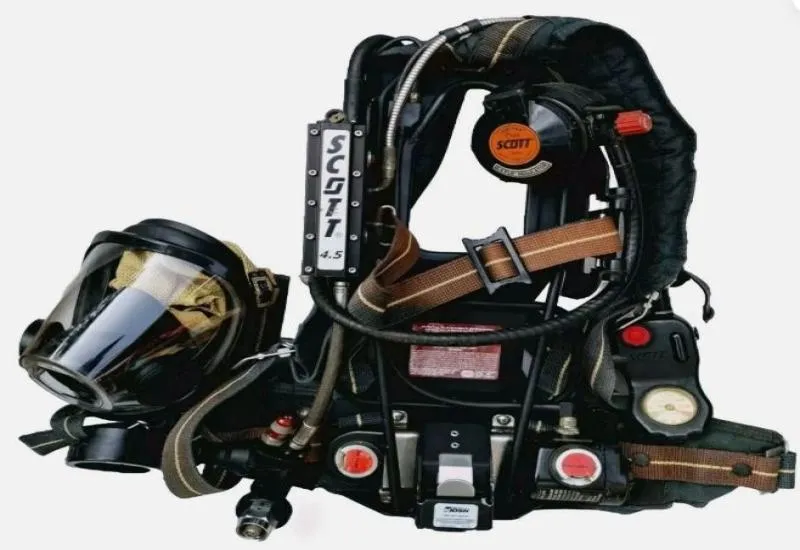
We have new and used SCBA (Self-Contained Breathing Apparatus) units in stock from well-known respirator brands for confined spaces and oxygen-deficient atmospheres. We also carry gas detectors with alarms and tripods for confined space access.
Self-contained breathing apparatus (SCBA) are respiratory protection devices designed to supply breathable air to users in environments where the atmosphere may be hazardous or oxygen-deficient. This equipment is essential in rescue, emergency response, chemical industry, mining, confined space work and firefighting.
WHAT IS A SELF-CONTAINED BREATHING APPARATUS?
An SCBA (Self-Contained Breathing Apparatus) allows the user to breathe compressed air from a cylinder independent of the surrounding environment. This sets it apart from other devices that filter the ambient air.
Main components:
- Compressed air cylinder (usually steel or carbon fiber).
- Harness or backpack to secure the equipment to the body.
- Pressure gauge and valves .
- Pressure regulator (primary and secondary).
- Airtight face mask.
- Audible alarm system (warns when air pressure is low).
- Demand valve or positive-pressure valve.
TYPES OF SELF-CONTAINED BREATHING APPARATUS
|
Type |
Characteristics |
Typical Duration |
|
Positive pressure |
Maintains pressure above atmospheric to prevent contaminants from entering |
30-60 minutes |
|
Negative pressure |
Air enters only when the user inhales |
Less common, less safe |
|
Open-circuit |
Exhaled air is released into the environment |
General use |
|
Closed-circuit |
Recirculates and purifies exhaled air (longer use) |
Up to 4 hours (e.g. mining, submarines) |
MAIN USES
- Firefighters: Protection against smoke, toxic gases and heat.
- Petrochemical industry: Handling of volatile or toxic substances.
- Confined spaces: Wells, tunnels, tanks, underground chambers.
- Rescue and emergency: Environments with potentially lethal atmospheres.
- Wastewater treatment plants: Risk of gases such as H₂S.
CURRENT REGULATIONS AND STANDARDS
Regulations vary by country but are generally based on international safety standards:
International Standards:
- NIOSH (U.S.) – Certifies respirators (National Institute for Occupational Safety and Health).
- NFPA 1981 – SCBA standard for firefighters (National Fire Protection Association).
- OSHA 29 CFR 1910.134 – Respiratory protection requirements in the workplace (U.S.).
- ISO 23269 – Equipment for use on ships.
- EN 137 (Europe) – Standard for positive-pressure SCBA.