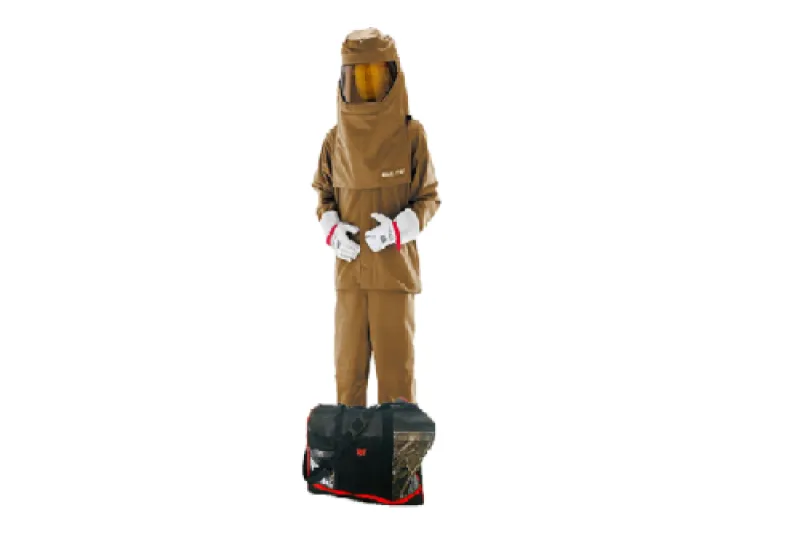
To work in environments with live voltages, regulations require glove protection, and an arc flash suit is a set of specialized clothing designed to protect the worker from the thermal and explosive effects of an electric arc, such as:
- Extreme temperatures (up to 20,000 °C in milliseconds).
- Flames and sparks.
- Pressure and blast waves.
- Molten metal fragments.
What is an arc flash?
An electric arc occurs when electricity jumps through the air between two conductors due to a fault, short circuit, or human error. It is one of the most dangerous forms of electrical accident.
What does an arc flash suit include?
Depending on the level of protection required (in cal/cm², per the NFPA 70E standard), the suit may include:
|
Component |
Function |
|
Jacket and pants or coveralls |
Made of flame-resistant and arc-rated material. |
|
Hood with face shield (arc flash hood) |
Protects the head, face, and neck from heat and particles. |
|
Insulating and protective gloves |
Insulation against current and mechanical protection. |
Classification by incident energy level (ARC categories)
According to the NFPA 70E standard, suits are classified by protection level:
|
ARC Category |
Heat withstood (cal/cm²) |
Example of work |
|
CAT 1 |
4 cal/cm² |
Basic switchboard operation |
|
CAT 2 |
8 cal/cm² |
Work in motor control centers |
|
CAT 3 |
25 cal/cm² |
Maintenance on medium-voltage systems |
|
CAT 4 |
40 cal/cm² or more |
Operations on transformers or substations |
When should it be worn?
Whenever tasks with arc flash risk are performed, such as:
- Work on energized switchboards.
- Maintenance of switchgear cells or substations.
- Cable testing with HiPot or VLF.
- Energization/de-energization switching operations.
Related standards
- NFPA 70E – Standard for electrical safety in the workplace.
- ASTM F1506 – Requirements for flame-resistant fabric.
- OSHA 1910 Subpart S – Electrical safety regulations.
Benefits of using it
- Saves lives.
- Reduces burns and serious injuries.
- Complies with legal and occupational safety regulations